
GVWR, Payload, and Empty Weight Explained
GVWR is the most a loaded trailer may weigh. Payload is GVWR minus empty weight. How to read the label, find real payload, and check tongue weight and GCWR.
By Strank Trailers10 min read
The short version
- Payload is GVWR minus the trailer's actual empty weight. It is not the number in the model name.
- A "14K" or "7-ton" dump trailer is rated for 14,000 lb total. Real payload is usually 9,000 to 10,000 lb, and less once options are added.
- The federal certification label on the front half of the left side lists GVWR, each GAWR, the build date, and the VIN. It is the rating that counts.
- Weighing the empty trailer on a certified scale costs about $15 and is the only way to know your real payload.
- Tongue weight comes out of your truck's payload. GCWR limits the truck and trailer together.
On this page
GVWR (gross vehicle weight rating) is the most your trailer is allowed to weigh, trailer plus load. Payload is what is left for cargo after you subtract the trailer's own empty weight: payload = GVWR − empty weight. A dump trailer with a 14,000-lb GVWR that weighs 4,500 lb empty can legally carry 9,500 lb, and not a pound more.
That math is simple. The trouble starts with where the numbers come from. Model names, brochure payloads, and "7-ton" stickers often don't match what the trailer can actually carry. This guide covers every rating you'll see, how to read the label, and how to find your real payload.
The weight ratings, defined
These are the terms you'll find on labels, spec sheets, and your truck's door jamb.
| Term | What it means | Where to find it |
|---|---|---|
| GVWR | Max total weight of the loaded trailer | Trailer certification label |
| GAWR | Max weight one axle may carry | Trailer certification label, one per axle |
| Empty (curb) weight | What the trailer weighs with no cargo | Spec sheet, MSO, or a scale |
| Payload | GVWR minus empty weight | Calculated |
| Tongue weight | Downward force on the hitch | Measured on a scale |
| GCWR | Max weight of truck plus trailer together | Tow vehicle's manual or label |
GVWR (gross vehicle weight rating)
GVWR is the manufacturer's rating for the fully loaded trailer: frame, box, hoist, battery, tarp, ramps, cargo, all of it. It covers the weight on the trailer's axles plus the weight on the hitch.
The manufacturer sets GVWR from the weakest link in the system: axles, tires, wheels, frame, coupler, and jack. That is why you can't raise GVWR by bolting on bigger tires. The label number stays the number.
GAWR (gross axle weight rating)
GAWR is the most a single axle assembly may carry, including its springs, hubs, wheels, and tires. A tandem 14K dump trailer usually has two 7,000-lb axles, and the label lists a GAWR for each.
On a bumper-pull trailer, the GAWRs often add up to about the GVWR. On some trailers they add up to less, because the hitch carries part of the load. Either way, you have to stay under every rating at once: each GAWR and the GVWR.
Empty weight (curb weight, tare weight)
Empty weight is what the trailer weighs with nothing in it. Spec sheets also call it curb weight, dry weight, or tare weight. Dump trailers are heavy because the box, hoist, and frame are heavy. Published spec sheets for common 7 x 14 ft, 14,000-lb GVWR low-profile dumps with 2-ft sides list empty weights of roughly 4,000 to 4,500 lb. High sides, thicker floors, and more options push that toward 5,000 lb.
Payload
Payload is your cargo allowance: GVWR minus empty weight. Every pound the builder adds (thicker steel, high sides, a spare tire, a toolbox) comes out of payload. That tradeoff is real, and steel thickness is a big part of it. A heavier box usually lasts longer, but you give up some legal capacity.
GCWR (gross combination weight rating)
GCWR is set by the truck manufacturer. It is the most the loaded truck and loaded trailer may weigh together. You'll find it in the owner's manual or the towing guide for your exact truck configuration. Engine, axle ratio, and cab and bed choice all change it.
Tongue weight
Tongue weight (also called hitch weight) is how much of the trailer's weight presses down on the hitch ball or gooseneck ball. Common guidance is 10–15% of the loaded trailer's weight for a bumper pull and roughly 15–25% for a gooseneck. Too little tongue weight causes sway. Too much overloads the truck's rear axle and payload. Our guide on how to load a dump trailer covers where to put the load to get it right.
How to read the trailer's certification label
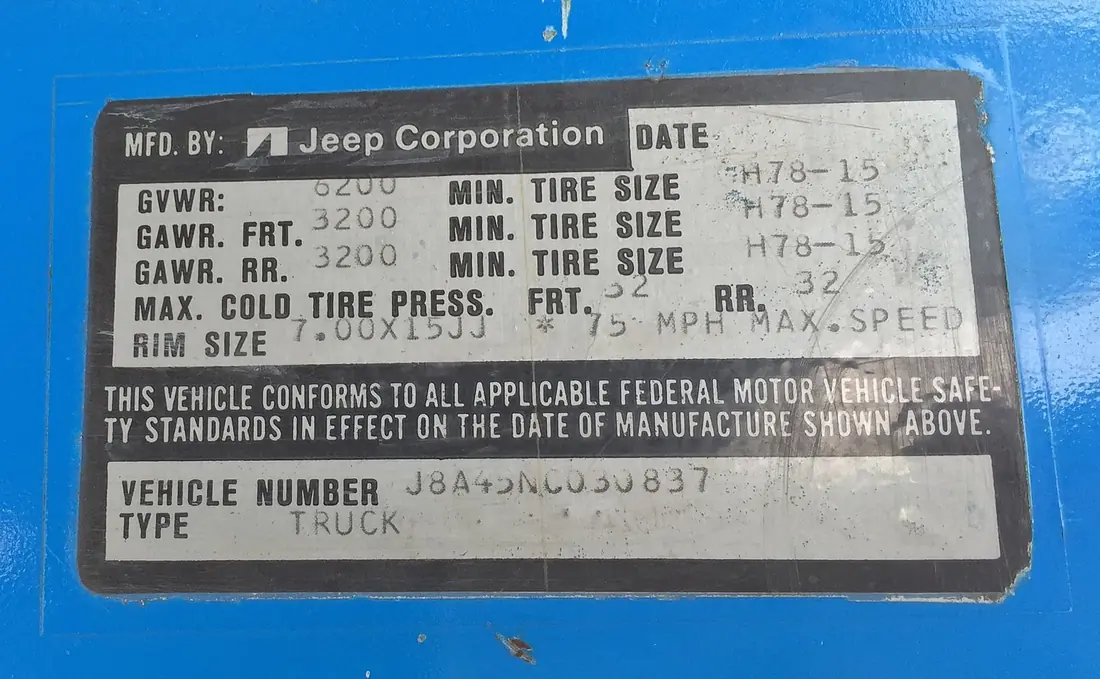
Every trailer built for US roads must carry a federal certification label under 49 CFR 567.4. On trailers, the regulation says the label goes on "the forward half of the left side, such that it is easily readable from outside the vehicle." On most dump trailers, look on the driver's side of the tongue or the front of the frame rail.
The label must show:
- Manufacturer name, after "Manufactured by" or "Mfd by"
- Month and year of manufacture
- GVWR in pounds (most also list kilograms)
- GAWR for each axle, listed front to rear
- A statement that the vehicle conforms to all applicable Federal Motor Vehicle Safety Standards in effect on the date of manufacture
- The 17-character VIN
- The vehicle type, which here is "TRAILER"
For trailers over 10,000 lb GVWR, which covers most dump trailers, FMVSS 120 also requires the tire size, rim size, and cold inflation pressure for each axle. That goes either after each GAWR or on a separate tire label. Trailers at or under 10,000 lb get a tire and loading placard under FMVSS 110 that reads, "The weight of cargo should never exceed XXX kilograms or XXX pounds."

Reading the VIN
The VIN identifies the trailer. It does not give its weight rating. A few positions are worth knowing:
- Positions 1–3 are the World Manufacturer Identifier (WMI), which identifies the builder.
- Position 10 is the model year. For example, S = 2025, T = 2026, V = 2027.
- Positions 12–17 are the production sequence number on most trailers. Small builders (under 1,000 vehicles a year) use positions 12–14 as part of their identifier.
Make sure the VIN on the label matches the VIN on the title or Manufacturer's Statement of Origin (MSO) and any VIN stamped into the frame. On a used trailer, a mismatch is a red flag.
Why the stated payload can be misleading
Payload is only as accurate as the empty weight behind it, and that empty weight is often optimistic. Here's where the gap comes from.
The model name is the GVWR, not the payload
"14K," "7-ton," and "14,000 lb" in a dump trailer's name nearly always mean GVWR. A "7-ton" trailer can't carry 7 tons of gravel. It can carry 7 tons total, trailer included. Once you subtract a 4,000–5,000 lb trailer, you have roughly 4.5–5 tons of cargo.
Brochure weights are often for the base trailer
The published empty weight is often for the base trailer with standard equipment. Options add weight that doesn't show up in that number:
- Slide-in ramps: often 100–200 lb a pair, depending on length and construction
- Tarp kit and arms
- High sides or side extensions
- Spare tire and wheel
- Deep-cycle battery and battery box
- Toolbox, upgraded floor, or heavier jack
On top of that, steel plate and tube are made to thickness tolerances, and welds and paint add weight. Two "identical" trailers can weigh a little differently.
The fix: weigh it
A certified truck scale gives you the real number. At a CAT Scale location (most large truck stops have one), a first weigh costs about $15 and a reweigh within 24 hours costs a few dollars (CAT Scale reweigh policy; pricing varies by location).
Here's how to weigh an empty trailer and find tongue weight:
- Weigh 1: Pull on with the empty trailer hitched. Put the truck's steer axle on platform 1, its drive axle on platform 2, and the trailer axles on platform 3.
- Weigh 2: Unhitch the trailer somewhere off the scale and reweigh the truck alone, in the same positions, with the same people and gear aboard.
- Tongue weight = truck weight hitched (platforms 1 + 2 in Weigh 1) − truck weight alone (Weigh 2).
- Trailer empty weight = trailer axle weight (platform 3 in Weigh 1) + tongue weight.
Do it with the trailer equipped the way you actually run it: battery in, ramps stowed, tarp on, spare mounted.
Worked examples
These examples use round numbers. Swap in your own trailer's label numbers and scale weights. Our load calculator will do the material math for you.
Example 1: Real payload on a 7 x 14 dump
- Label GVWR: 14,000 lb (two 7,000-lb axles)
- Brochure empty weight: 4,200 lb, so brochure payload is 9,800 lb
- Scale weight as equipped (ramps, tarp, battery, spare): 4,650 lb
- Real payload: 14,000 − 4,650 = 9,350 lb
That 450-lb gap is about a sixth of a cubic yard of gravel. It doesn't sound like much until you're loading by the bucket and assuming you have more room than you do.
Example 2: Volume vs. weight
The box in Example 1 is about 14 ft long, 83 in wide (about 6.9 ft), and 2 ft high on the sides:
- 14 × 6.9 × 2 = about 193 cu ft, or about 7.2 cubic yards level-full
Crushed stone weighs roughly 2,400–2,900 lb per cubic yard depending on size and moisture (see our material weight chart). At 2,800 lb per yard:
- 9,350 ÷ 2,800 = about 3.3 cubic yards
So the box holds more than twice the gravel you can legally carry. With dense material on a dump trailer, weight runs out long before space does. Mulch is different: at a fraction of the weight per yard, you can often fill the box.
Example 3: Tongue weight vs. truck payload
Now load that trailer to its full 14,000 lb and hitch it to a 3/4-ton pickup:
- Tongue weight at 12% of 14,000 lb: 1,680 lb
- Driver and passenger: 380 lb
- Tools and fuel cans in the bed: 250 lb
- Hitch receiver and ball mount: 50 lb
- Total load on the truck: 2,360 lb
Say the truck's door-jamb sticker reads "The combined weight of occupants and cargo should never exceed 2,150 lb." This truck is 210 lb over its payload, even though the trailer itself is legal. Tongue weight is cargo as far as your truck is concerned. Our guide on what truck you need for a dump trailer goes deeper on this.
Example 4: GCWR
Same truck, which weighs 7,300 lb at the scale with people and gear aboard:
- Truck: 7,300 lb
- Trailer: 14,000 lb
- Combined: 21,300 lb
If the truck's GCWR is 21,000 lb, you are over, even though the trailer is under its GVWR. Check all four limits every time: trailer GVWR, each trailer GAWR, truck payload and rear GAWR, and GCWR.
Ratings also matter for licensing. Under federal rules, a combination with a GCWR of 26,001 lb or more, towing a trailer rated over 10,000 lb, can require a Class A CDL when used in commerce. See Do You Need a CDL to Pull a Dump Trailer?.
Why the ratings are set where they are
A GVWR is only as honest as the parts behind it. A 14,000-lb rating needs axles, springs, tires, wheels, a frame, a coupler, and a jack that can all carry it with margin, over years of washboard roads and loads dropped from a skid steer bucket. Two trailers with the same GVWR can be built very differently. One has a thicker floor, deeper frame rails, and more crossmembers. That weighs more and costs more up front, and it also holds its shape and resale value longer. That's the core argument of why cheap dump trailers cost more.
GVWR also has legal effects beyond the scale. In many states it sets registration fees and inspection rules. For commercial use, a GVWR or GCWR over 10,000 lb can trigger federal DOT number and inspection requirements. Rules vary by state, so check DOT Numbers, Inspections, and Registration for Dump Trailers and your state DMV.
The bottom line
Payload is GVWR minus the trailer's actual empty weight. Read the federal label, ignore the number in the model name, and spend $15 to weigh your trailer as equipped. Then check four limits on every load: trailer GVWR, each GAWR, your truck's payload, and GCWR. For heavy material, weight will run out long before box space does. Unfamiliar terms are defined in our glossary.
Frequently asked questions
What is the difference between GVWR and payload on a trailer?
GVWR is the maximum the trailer may weigh with its load. Payload is how much cargo you can add, which is GVWR minus the trailer's empty weight. A 14,000-lb GVWR trailer that weighs 4,500 lb empty has a 9,500-lb payload.
Can I put bigger tires on my trailer to raise the GVWR?
No. GVWR is set by the manufacturer from the weakest part of the trailer, including the axles, frame, coupler, and wheels. Bigger tires do not change the rating on the certification label, and that label is the rating enforcement and insurers go by.
Does tongue weight count toward trailer GVWR?
Yes. GVWR is the trailer's total weight, including the part carried by the hitch. Tongue weight also counts against your truck's payload and rear axle rating.
Where is the GVWR on a dump trailer?
It is on the federal certification label, which 49 CFR 567.4 requires on the forward half of the left (driver's) side of the trailer. Most builders put it on the tongue or the front of the frame rail. The label also lists each axle's GAWR, the VIN, and the month and year of manufacture.
Share this guide
Link to this guide
Writing about dump trailers? You're welcome to quote this guide and link to it. Copy whichever format you need.
- URL
- https://stranktrailers.com/guides/gvwr-payload-explained
- HTML link
- <a href="https://stranktrailers.com/guides/gvwr-payload-explained">GVWR, Payload, and Empty Weight Explained</a> (Strank Trailers)
- Citation
- Strank Trailers. "GVWR, Payload, and Empty Weight Explained." stranktrailers.com, October 28, 2026. https://stranktrailers.com/guides/gvwr-payload-explained
Keep reading
Ownership · 9 min read
How to Load a Dump Trailer
How to load a dump trailer safely: tongue weight targets, front-to-back placement, loading with a skid steer or excavator, material weights, GVWR, and tarping.
Business · 10 min read
Material Weight Chart: Gravel, Dirt, Sand, Mulch, and More
Material weight chart in pounds and tons per cubic yard for gravel, dirt, sand, mulch, concrete, and debris, plus how many yards a dump trailer can haul.
Towing · 11 min read
What Truck Do You Need to Pull a Dump Trailer?
What truck you need to pull a dump trailer: half-ton vs. 3/4-ton vs. 1-ton, payload vs. towing capacity, hitch ratings, and real combos for 7k to 20k+ trailers.