
Dump Trailer Brakes: Electric, EOH, Breakaway, and Controllers
How dump trailer brakes work: electric drum vs. electric-over-hydraulic disc, brakes on all axles, breakaway batteries, brake controllers, and gain settings.
By Strank Trailers12 min read
The short version
- Most dump trailers use electric drum brakes on every axle. Electric-over-hydraulic (EOH) disc brakes cost more but stop harder and hold up better to heat and water.
- Federal rules require brakes on all wheels of a commercial motor vehicle, and that includes a dump trailer pulled for business across state lines.
- A breakaway system has to apply the trailer brakes on its own and hold them for at least 15 minutes. That only works if the battery is charged and the lanyard is rigged right.
- A proportional brake controller is the right match for a dump trailer, because the weight you're towing can triple between an empty run and a loaded one.
- Set controller gain on a dry road at 20 to 25 mph: aim for strong braking just short of wheel lockup, and reset it every time the load changes a lot.
On this page
- How dump trailer brakes work: the system at a glance
- Electric drum brakes: the standard setup
- Electric-over-hydraulic (EOH) disc brakes
- Do dump trailers need brakes on all axles?
- Breakaway systems and batteries
- Brake controllers: proportional vs. time-delayed
- How to set brake controller gain
- Brake maintenance that actually matters
- State trailer brake laws: the general picture
- The bottom line
Nearly every dump trailer rated 7,000 lb GVWR and up uses electric drum brakes on every axle. They run off a brake controller in the truck cab, and a battery-powered breakaway system locks them if the trailer ever comes loose. Heavier trailers, and owners who haul loaded through hills, are moving to electric-over-hydraulic (EOH) disc brakes, which stop harder and resist fade. Whichever system you have, it only works as well as the controller setting and the maintenance behind it.
This guide covers how each system works, what federal and state law requires, how breakaway systems and their batteries work, the choice between proportional and time-delayed controllers, and how to set gain correctly.
How dump trailer brakes work: the system at a glance
A trailer brake system is a chain of parts, and it's only as good as the weakest one. Here's what's in that chain and what to look at on each part.
| Component | Where it lives | What it does | What to check |
|---|---|---|---|
| Brake controller | Truck cab | Sends a variable signal to the trailer brakes | Type (proportional vs. time-delayed), gain setting |
| 7-way connector and wiring | Truck bumper to trailer tongue | Carries the brake signal, 12V charge line, and ground | Corrosion, loose pins, chafed wires |
| Brake assemblies | Each wheel | Turn that signal into stopping force | Shoes or pads, magnets, drums or rotors |
| Breakaway switch and battery | Trailer tongue | Applies the brakes if the trailer separates | Battery charge, pin, lanyard routing |
| EOH actuator (if equipped) | Trailer tongue | Turns the electric signal into hydraulic pressure | Fluid level, lines, fault indicators |
If you're new to the terms, our glossary defines GVWR, GAWR, and the rest.
Electric drum brakes: the standard setup
Electric drum brakes are standard on most bumper-pull dump trailers. When you press the brake pedal, the controller sends current to an electromagnet inside each brake drum. The magnet grips the spinning face of the drum and gets dragged along with it. That swings a lever, and the lever pushes the brake shoes out against the drum.
The more current the controller sends, the harder the magnet grabs and the harder the trailer brakes. That's why the controller setting matters so much.
Sizes you'll see
Drum size follows axle capacity. On 7,000 lb axles, the typical spec is 12 x 2 in. electric brakes. Axles rated 8,000 to 10,000 lb typically get larger 12-1/4 x 3-3/8 in. brakes with more lining area. The exact spec varies by axle maker and model year, so check the trailer's spec sheet or the axle tag. Our guide to dump trailer axles and suspension covers how axle ratings drive the rest of the running gear.
Strengths and weaknesses
Electric drums are simple, inexpensive, and repairable almost anywhere. Parts are stocked at every trailer supply house, and they work with any standard electric brake controller.
Their weak spots are predictable:
- Heat fade. Drums lose stopping power as they get hot, which shows up on long downgrades with a full load.
- Water. Wet shoes grab poorly until they dry out.
- Wear and adjustment. Shoes, magnets, and drum faces all wear. Unless the brakes self-adjust, you have to adjust them by hand on a schedule.
- Wiring. One corroded splice or a weak ground can cut braking at every wheel.
Axle manufacturers publish maintenance schedules, and they typically include an initial brake adjustment after the first 200 miles, then periodic adjustment and inspection after that. Some axle makers offer self-adjusting electric brakes, which reduce that chore but don't remove the need to inspect.
Electric-over-hydraulic (EOH) disc brakes
An EOH system adds an actuator, which is a small electric pump and reservoir mounted on the trailer tongue. The truck's brake controller still sends an electric signal, but now it goes to the actuator. The actuator pressurizes brake fluid and sends it through steel lines to hydraulic calipers on disc rotors at each wheel. Some systems use hydraulic drums instead of discs.
The result feels a lot like the brakes on your truck: firm, consistent, and strong.
Why buyers choose EOH discs
- More stopping power and better consistency, especially loaded.
- Better heat tolerance. Rotors shed heat faster than drums, so they fade less on long descents.
- Better wet performance. Rotors throw off water quickly.
- Easier inspection. You can often check pad thickness and rotor condition without pulling the hub.
- No shoe adjustment. Disc brakes take up pad wear on their own.
The trade-offs
- Higher cost than electric drums, both up front and for replacement parts.
- More components. The actuator, brake lines, and fluid all need care, and the actuator sits on the tongue where it takes road spray and salt.
- Controller compatibility. Not every controller works well with every actuator. Some controllers have a dedicated EOH mode. Check the actuator maker's list of compatible controllers before you buy.
- Power supply. The actuator pump needs a solid 12-volt supply in addition to the brake signal. Undersized wiring or a weak connection shows up as weak or slow braking.
Electric drum vs. EOH disc
| Electric drum | EOH disc | |
|---|---|---|
| Stopping power | Good when adjusted | Stronger, more consistent |
| Heat fade on long grades | More prone | Less prone |
| Wet performance | Weak until dry | Good |
| Routine maintenance | Adjust shoes, check magnets | Check fluid, pads, lines, actuator |
| Upfront cost | Lower | Higher |
EOH makes the most sense on trailers rated 14,000 lb GVWR and heavier, on 20,000 lb-plus goosenecks, and for anyone running loaded on highways or through hills every day. On a 7,000 or 10,000 lb trailer used locally on flat ground, well-kept electric drums are a reasonable choice.
Do dump trailers need brakes on all axles?
For commercial use, yes. Under 49 CFR 393.42, every commercial motor vehicle must have brakes acting on all wheels. A pickup and dump trailer used for business in interstate commerce almost always qualifies as a commercial motor vehicle, because the combined weight rating is over 10,000 lb. So a tandem-axle dump trailer in that service needs working brakes on both axles. Our guide to DOT requirements for dump trailers explains how that threshold works.
State law sets the rules for intrastate and personal use, and the thresholds vary. Texas, for example, requires brakes on trailers with a gross weight over 4,500 lb. It allows trailers between 4,500 and 15,000 lb to run without brakes only at 30 mph or less (Texas Transportation Code 547.401). Other states set lower thresholds, and many require brakes on every wheel above a certain weight.
In practice, a loaded dump trailer is heavier than nearly every state's brake threshold. The real question is whether every axle has brakes. On a trailer that routinely carries several tons of rock, it should.
Breakaway systems and batteries
A breakaway system is your last line of defense if the coupler, ball, or hitch fails. A switch on the tongue is connected to the truck by a cable called a lanyard. If the trailer separates, the lanyard pulls a pin out of the switch. That connects a battery on the trailer straight to the brakes and applies them at full force.
Federal rules for commercial vehicles (49 CFR 393.43) require trailer brakes to "apply automatically and immediately upon breakaway" and to stay applied for at least 15 minutes. California's Vehicle Code (section 26304) uses the same 15-minute standard, and many other states have similar breakaway rules.
The breakaway battery
Most breakaway kits use a small sealed 12-volt battery. It's usually kept charged through the 12V auxiliary pin on the 7-way connector, often with a small charger built into the breakaway box. On some dump trailers the breakaway system runs off the main hydraulic pump battery instead. Find out which design you have. If the breakaway shares the pump battery, then running the pump battery flat also leaves you with no breakaway braking.
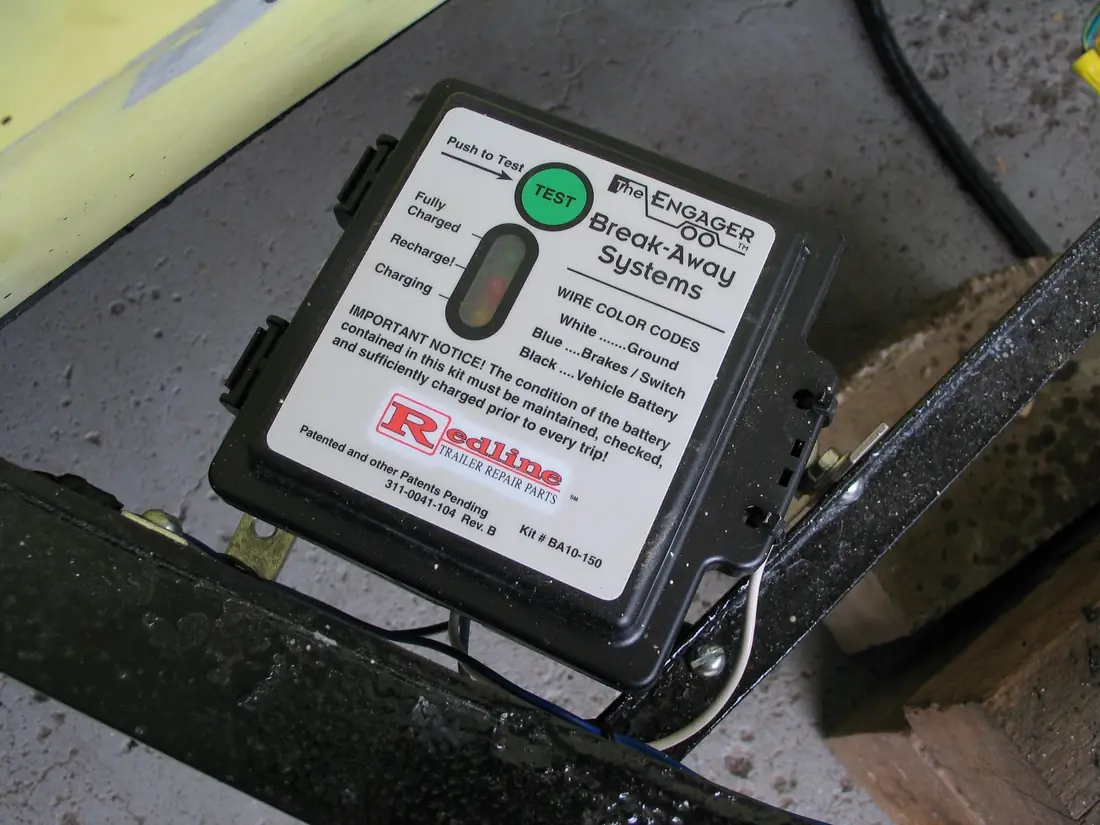
EOH systems have breakaway protection too. The breakaway switch powers the actuator pump from the battery so it can build hydraulic pressure on its own.
For more on batteries and charging, see our guide to dump trailer hydraulics and batteries.
How to rig and test it
- Attach the lanyard to the truck on its own, not to a safety chain or a chain hook. If the chain goes, the lanyard has to stay behind with the truck.
- Leave enough slack for tight turns, but not so much that the cable drags on the road.
- Test before trips. With the trailer hooked up, pull the pin and try to pull ahead slowly. The trailer brakes should drag hard. Put the pin back right away, because leaving it out drains the battery.
- Check the battery. Use a voltmeter or the tester built into many breakaway boxes. Replace the battery when it no longer holds a charge.
Brake controllers: proportional vs. time-delayed
The brake controller decides how much braking the trailer gets and when. There are two basic types.
Proportional controllers
A proportional controller senses how hard the truck is slowing down and applies the trailer brakes to match. Aftermarket units use a built-in motion sensor. Factory-integrated controllers, offered on most current heavy-duty pickups, use data from the truck's own brake system. Brake gently and the trailer brakes gently. Stomp the pedal and the trailer brakes hard right away.
Time-delayed controllers
A time-delayed controller ramps up to a preset output over a fixed time after you touch the brake pedal. It does this no matter how hard you're actually stopping. Most let you adjust that ramp-up time, sometimes called "sync." They're cheaper and simpler, but a light touch can get too much trailer braking and a panic stop can get too little.
Which one fits a dump trailer
| Proportional | Time-delayed | |
|---|---|---|
| How braking is applied | Matches truck deceleration | Ramps to a set level over time |
| Smoothness in traffic | Smooth | Can feel grabby or late |
| Panic stops | Full braking right away | Lag before full output |
| Changing loads | Handles them better | Needs frequent readjustment |
| Cost (2026, aftermarket) | Typically about $100 to $300 plus install | Usually less |
A dump trailer might weigh 4,000 to 5,000 lb empty and 14,000 lb loaded. That big weight swing is exactly what proportional controllers are built for. If your truck offers a factory-integrated controller, it's usually the cleanest option. Prices vary by brand and retailer, so treat the range above as a rough guide.
Every controller also has a manual override, a lever or button that applies only the trailer brakes. Learn where it is without looking. A gentle, steady pull on the manual control is a common way to straighten a trailer that has started to sway. Don't hit the truck's brakes hard in that moment.
How to set brake controller gain
Gain is the maximum power the controller sends to the trailer brakes. Set it too low and the truck does most of the stopping, which overheats its brakes and lets the trailer push. Set it too high and the trailer wheels lock and skid, which is especially easy with an empty dump trailer.
There is no correct number that works for every trailer. Set it by test:
- Hook up and connect. Make sure the controller shows a trailer connected. For aftermarket proportional units, follow the manual's leveling or mounting-angle setup.
- Start at the manual's suggested setting for your trailer weight.
- Find a dry, level, empty stretch of pavement or a large lot.
- At 20 to 25 mph, apply the manual override fully, without touching the brake pedal.
- Adjust. If the trailer wheels lock, lower the gain. If braking feels weak, raise it. You want strong braking just short of lockup.
- Repeat with a load. A loaded trailer needs noticeably more gain than an empty one.
Some controllers also have a boost setting, which adds extra trailer braking right at the start of a stop for heavy trailers. Use it if the manual recommends it for your trailer weight.
Brake maintenance that actually matters
Trailer brakes fail slowly and quietly, so routine checks matter. The essentials:
- Bearings and seals. Brakes and wheel bearings share the hub. A failed grease seal soaks the brake shoes, and grease-soaked shoes barely stop. Replace contaminated shoes. Don't try to clean them.
- Magnets and shoes on electric drums. Check them for wear at the intervals in the axle maker's manual. A magnet worn through its friction surface can't grip the drum.
- Drums and rotors. Look for scoring, cracks, or a heat-glazed surface.
- Wiring and grounds. Clean and protect the 7-way pins, and check splices and the ground connection. Electrical problems cause much of the weak trailer braking out there.
- EOH systems. Check the fluid level, look for leaks at lines and calipers, and keep the actuator clean.
Our dump trailer maintenance checklist puts all of this on a schedule. If you're shopping used, the used dump trailer inspection checklist shows how to spot neglected brakes before you buy.
State trailer brake laws: the general picture
Brake requirements for non-commercial trailers are set state by state. They differ in:
- The weight that triggers a brake requirement. Some states set it below 2,000 lb, and others set it higher (Texas uses 4,500 lb gross).
- Whether every wheel needs brakes, or only some of them, above certain weights.
- Breakaway requirements, including how long the brakes must hold.
- Whether the driver must be able to work the trailer brakes from the cab.
If you use the rig for business in interstate commerce, the federal rules above apply on top of state law. Check your state's vehicle code or state police commercial vehicle unit, plus the rules of any state you'll drive through.
The bottom line
Electric drum brakes on every axle are the standard for dump trailers. They work well when they're adjusted, wired cleanly, and paired with a proportional controller. EOH disc brakes cost more and are worth it on heavy trailers, in hill country, and for daily highway work. Whatever you run, keep the breakaway battery charged and the lanyard rigged on its own, and reset your gain when the load changes. To see how brakes fit into total ownership cost, read why cheap dump trailers cost more.
Frequently asked questions
Do dump trailers need brakes on both axles?
If the trailer is part of a commercial motor vehicle under FMCSA rules, federal law (49 CFR 393.42) requires brakes on all wheels. Most states also require brakes on trailers well below dump-trailer weights, so brakes on every axle is the right standard regardless.
What kind of brake controller is best for a dump trailer?
A proportional controller, either a factory-integrated unit or a quality aftermarket inertia-sensing model. It matches trailer braking to how hard the truck is stopping, which matters on a trailer whose weight swings by thousands of pounds between empty and loaded.
How long does a breakaway system have to hold the brakes?
Federal rules for commercial vehicles (49 CFR 393.43) say the trailer brakes must apply automatically on breakaway and stay applied for at least 15 minutes. Several states, including California, use the same 15-minute standard.
Are electric-over-hydraulic disc brakes worth it on a dump trailer?
They're worth considering if you pull 14,000 lb GVWR or heavier, work in hilly country, or run loaded at highway speed every day. For lighter trailers on mostly flat local routes, well-maintained electric drums do the job for less money.
What should I set my brake controller gain to?
There is no universal number. Set it on a dry, level surface at 20 to 25 mph: apply the manual control fully and raise the gain until the trailer wheels are just short of locking. Then repeat the test once the trailer is loaded.
Share this guide
Link to this guide
Writing about dump trailers? You're welcome to quote this guide and link to it. Copy whichever format you need.
- URL
- https://stranktrailers.com/guides/dump-trailer-brakes
- HTML link
- <a href="https://stranktrailers.com/guides/dump-trailer-brakes">Dump Trailer Brakes: Electric, EOH, Breakaway, and Controllers</a> (Strank Trailers)
- Citation
- Strank Trailers. "Dump Trailer Brakes: Electric, EOH, Breakaway, and Controllers." stranktrailers.com, October 28, 2026. https://stranktrailers.com/guides/dump-trailer-brakes
Keep reading
Specs · 10 min read
Dump Trailer Axles and Suspension
Dump trailer axles and suspension explained: 5.2k to 12k axle ratings, tandem vs. triple, slipper springs vs. torsion, hubs, and axle capacity vs. GVWR.
Towing · 11 min read
DOT Numbers, Inspections, and Registration for Dump Trailers
Dump trailer DOT requirements explained: when you need a USDOT number, medical card, annual inspection, IFTA/IRP, and how trailer titles and plates work.
Specs · 9 min read
Dump Trailer Hydraulics, Pumps, and Batteries
How dump trailer hydraulics work: 12V pumps, single- vs. double-acting, fluid, deep-cycle batteries, 7-way and solar charging, remotes, and safety props.