
What Size Dump Trailer Do I Need?
Dump trailer sizes from 5x8 to 8x20, with cubic-yard capacity at 2, 3 and 4 ft sides, typical GVWR, and why weight, not volume, decides what size you need.
By Strank Trailers10 min read
The short version
- Pick a dump trailer by payload (GVWR minus empty weight) first and box volume second, because heavy materials hit the weight limit long before the box is full.
- Capacity in cubic yards is length x inside width x side height in feet, divided by 27; a 7x14 with 4 ft sides holds about 14.3 cubic yards level-full.
- A 14,000 lb GVWR 7x14 can legally carry only about 3.3 cubic yards of gravel, roughly a quarter of what a 4 ft box holds.
- Tall sides earn their keep on light, bulky loads like mulch, brush, and cleanouts; for rock, dirt, and concrete, 2 ft sides are usually enough.
- The 7x14, 14,000 lb GVWR tandem-axle trailer is the most common contractor size, but it needs a 3/4-ton or 1-ton truck to tow safely.
On this page
The right dump trailer size depends on two numbers: how much weight you need to carry per load and how bulky your material is. For most homeowners and light landscaping, a 5x10 or 6x10 rated around 7,000 to 10,000 lb GVWR is enough. For contractors hauling gravel, dirt, and debris every day, the 7x14 with a 14,000 lb GVWR is the standard workhorse, and 16 to 20 ft goosenecks rated 20,000 lb and up take over when you need more payload.
The mistake most first-time buyers make is choosing by box size. A big box is easy to fill with rock, and that is exactly the problem. Heavy materials hit a trailer's weight limit long before the box is full, so payload decides what a dump trailer can really do. This guide shows the math, the common sizes, and how to match a trailer to your truck and your work.
Common dump trailer sizes at a glance
Dump trailer sizes are listed as inside width by inside length in feet. A "7 ft" wide trailer is usually 83 inches inside, because the box sits between the fenders and the whole trailer has to stay within the 102-inch federal width limit. "8 ft" wide trailers (96 inches) are typically deckovers, where the box sits above the wheels.
| Size | Typical GVWR | Axles | Approx. payload | Common uses |
|---|---|---|---|---|
| 5x8 | 3,000–5,200 lb | Single | 1,500–3,300 lb | Yard cleanup, small homeowner jobs |
| 5x10 | 5,200–7,000 lb | Single or tandem | 3,000–5,300 lb | Homeowners, lawn maintenance |
| 6x10 | 7,000–9,990 lb | Tandem | 4,500–7,300 lb | Landscaping, small remodels |
| 6x12 | 9,990–12,000 lb | Tandem | 6,500–9,000 lb | Landscaping, roofing, cleanouts |
| 7x12 | 12,000–14,000 lb | Tandem | 8,000–10,000 lb | General contracting |
| 7x14 | 14,000 lb (some to 17,600) | Tandem | 9,500–11,000 lb | Contractors, hardscape, demolition |
| 7x16 | 14,000–21,000 lb | Tandem or triple | 9,500–13,500 lb | Heavy contracting, site work |
| 8x16 | 14,000–24,000 lb | Tandem | 10,000–16,000 lb | Deckover and gooseneck work |
| 8x20 | 20,000–30,000 lb | Tandem dual | 13,000–20,000 lb | Aggregate hauling, large demo |
These are typical ranges from current manufacturer spec sheets, not hard rules. The same 7x14 box might be built at 10,000, 14,000, or 17,600 lb GVWR depending on the axles, frame, and tires underneath it. GVWR (gross vehicle weight rating) is the maximum the trailer is allowed to weigh fully loaded. Payload is GVWR minus the trailer's empty weight. Our guide to GVWR, payload, and empty weight explains how those numbers fit together.
How to calculate dump trailer capacity in cubic yards
Material is sold by the cubic yard or by the ton, so you want to know your trailer's volume in cubic yards. The formula is simple:
Cubic yards = inside length (ft) x inside width (ft) x side height (ft) / 27
There are 27 cubic feet in a cubic yard (3 ft x 3 ft x 3 ft). Always use inside dimensions, and convert inches to feet by dividing by 12.
Here is a 7x14 with 2 ft sides worked out:
- Inside width: 83 in / 12 = 6.92 ft
- Inside length: 14 ft
- Side height: 2 ft
- 14 x 6.92 x 2 = 193.7 cubic feet
- 193.7 / 27 = 7.2 cubic yards
That is a level-full (struck) volume. A heaped load holds more, but heaping past the sides is how material ends up on the highway, and most states require loose loads to be contained or covered.
Dump trailer capacity chart: 2 ft, 3 ft, and 4 ft sides
| Size (inside width) | 2 ft sides | 3 ft sides | 4 ft sides |
|---|---|---|---|
| 5x8 (60 in) | 3.0 yd³ | 4.4 yd³ | 5.9 yd³ |
| 5x10 (60 in) | 3.7 yd³ | 5.6 yd³ | 7.4 yd³ |
| 6x10 (72 in) | 4.4 yd³ | 6.7 yd³ | 8.9 yd³ |
| 6x12 (72 in) | 5.3 yd³ | 8.0 yd³ | 10.7 yd³ |
| 7x12 (83 in) | 6.1 yd³ | 9.2 yd³ | 12.3 yd³ |
| 7x14 (83 in) | 7.2 yd³ | 10.8 yd³ | 14.3 yd³ |
| 7x16 (83 in) | 8.2 yd³ | 12.3 yd³ | 16.4 yd³ |
| 8x16 (96 in) | 9.5 yd³ | 14.2 yd³ | 19.0 yd³ |
| 8x20 (96 in) | 11.9 yd³ | 17.8 yd³ | 23.7 yd³ |
Manufacturers sometimes quote slightly different numbers because inside widths vary by an inch or two, and some measure to the top of a tarp shroud. As a cross-check, Load Trail lists 8.20 cubic yards for its 83-inch x 16 ft DH20 with 24-inch sides, which matches the 7x16 figure above.
Volume vs. weight: why a bigger box doesn't mean a bigger load
This is the single most important thing to understand about dump trailer sizes.
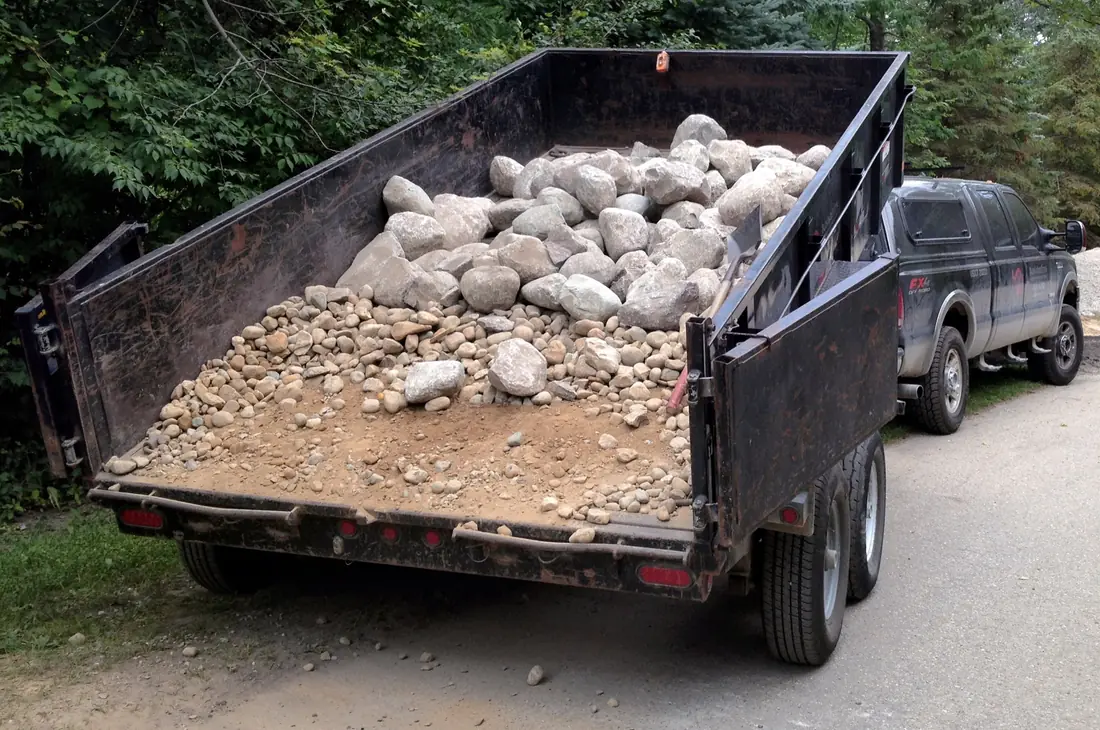

Take a 7x14 with 4 ft sides, rated 14,000 lb GVWR. Taller steel sides, ramps, a tarp system, and a spare add weight, so assume a realistic empty weight around 4,700 lb. That leaves about 9,300 lb of payload. The box holds 14.3 cubic yards. Here is how much of each material it can legally carry:
| Material | Approx. weight per yd³ | Max yards at 9,300 lb | Share of 4 ft box |
|---|---|---|---|
| Mulch (dry) | 600 lb | 14.3 (box is full first) | 100% |
| Mulch (wet) | 1,200 lb | 7.8 | 54% |
| Topsoil (dry, screened) | 2,200 lb | 4.2 | 29% |
| Broken concrete (loose) | 2,400 lb | 3.9 | 27% |
| Sand (dry) | 2,700 lb | 3.4 | 24% |
| Gravel / crushed stone | 2,800 lb | 3.3 | 23% |
Material weights vary with moisture, gradation, and source. Wet soil can weigh 20 to 30 percent more than dry. Use your supplier's number when you have it, and see our material weight chart for more materials.
Look at the gravel line. That 14-yard box reaches its legal limit with about 3.3 yards of gravel in it, which is a layer roughly 11 inches deep across the floor. Fill it to the top with gravel and you would be carrying about 40,000 lb on a trailer built for 9,300 lb of cargo. No 7x14 is built for that.
Our load calculator runs this math for any trailer and material.
So why buy tall sides at all?
Because not everything is heavy. Tall sides make sense when your material is light and bulky:
- Mulch and wood chips. At roughly 400 to 800 lb per yard dry, a 4 ft 7x14 can be filled to the top and stay under GVWR.
- Brush, leaves, and green waste. These run out of room long before they run out of weight.
- Cleanouts and light demolition. Furniture, drywall, framing lumber, and household junk are bulky and irregular.
For rock, dirt, sand, and concrete, 2 ft sides are usually enough. Lower sides make the trailer lighter (more payload), easier to load by hand or with a skid steer, and easier to see over in the mirrors. Some owners split the difference with removable mesh or expanded-metal side extensions they add only for mulch season.
What GVWR tells you about a dump trailer
Once you know the payload you need, GVWR narrows down the size quickly. Here are real examples from current manufacturer spec sheets. Specs change by model year and options, so check the current sheet before you buy.
| Model | Size | GVWR | Empty weight | Payload |
|---|---|---|---|---|
| Big Tex 70SR | 5x10 (60 in) | 7,000 lb | 1,730 lb | 5,270 lb |
| Big Tex 90SR-10 | 6x10 (72 in) | 9,990 lb | 2,750 lb | 7,240 lb |
| PJ D7 | 7x14 (83 in) | 14,000 lb | 3,660 lb | 10,340 lb |
| Big Tex 14LP | 7x12 to 7x16 (83 in) | 14,000 lb | 3,870–4,250 lb | 9,750–10,130 lb |
| PJ DD | 8x20 (96 in) | 25,000 lb | 8,840 lb | 17,500–19,160 lb |
Notice that empty weight climbs fast as trailers get bigger. Heavier floors, deeper frames, and bigger axles add steel, and steel is what lets a trailer survive years of heavy loading.
Matching dump trailer size to your tow vehicle
Your truck sets a hard ceiling on what size dump trailer makes sense. A dump trailer spends most of its working life near its GVWR, so plan as if it will always be fully loaded.
The number that trips people up is tongue weight. On a bumper-pull trailer, 10 to 15 percent of the loaded trailer's weight should rest on the hitch, and that weight counts against your truck's payload, along with passengers, tools, and fuel.
| Trailer GVWR | Tongue weight (10–15%) | Typical tow vehicle | Notes |
|---|---|---|---|
| 5,200–7,000 lb | 520–1,050 lb | Half-ton pickup | Check receiver rating and payload |
| 9,990–12,000 lb | 1,000–1,800 lb | 3/4-ton pickup | Half-tons often run out of payload here |
| 14,000 lb | 1,400–2,100 lb | 3/4-ton or 1-ton | Receiver must be rated for 14,000 lb |
| 16,000–21,000 lb | 3,200–5,250 lb (gooseneck at 20–25%) | 1-ton, usually gooseneck | Check GCWR and rear axle rating |
| 25,000–30,000 lb | 5,000–7,500 lb (gooseneck) | 1-ton dual rear wheel or larger | Often requires a Class A CDL for work use |
For a sense of scale, Ford rates the 2026 F-250 at up to 22,000 lb conventional towing and the F-350 dual-rear-wheel at up to 38,000 lb with a gooseneck, both when properly equipped. Your truck's actual ratings depend on engine, axle ratio, cab, and bed, so use the numbers on your door-jamb sticker and in the owner's manual. Our guide to what truck you need for a dump trailer goes deeper.
Two legal thresholds also follow trailer size:
- 10,001 lb. In interstate commerce, a truck and trailer rated 10,001 lb or more (GVWR or GCWR) is a commercial motor vehicle under FMCSA rules and generally needs a USDOT number. Many states apply similar rules to intrastate work.
- Over 10,000 lb trailer GVWR. If the trailer is rated over 10,000 lb and the combination is rated 26,001 lb or more, a Class A CDL is required when the combination is used in commerce.
That second rule is why some buyers pick a 9,990 lb trailer instead of a 10,000 lb one. See Do You Need a CDL to Pull a Dump Trailer? for how the combined rating is calculated and where states differ.
Matching dump trailer size to the job
Start with your most common load, not your heaviest possible one. Buying for a once-a-year job means towing extra steel the rest of the year.
- Homeowner and yard cleanup: 5x8 or 5x10, single or light tandem axle. Brush, a few yards of mulch, a bathroom remodel.
- Lawn maintenance crews: 5x10 to 6x12 around 7,000 to 10,000 lb GVWR, with a ramp option if you also carry mowers. See Best Dump Trailers for Landscapers.
- Landscape installation and hardscape: 6x12 or 7x14. Mulch wants taller sides; gravel and base want payload.
- Roofing tear-offs and cleanouts: 6x12 to 7x16 with 3 to 4 ft sides, since debris is bulky. Shingles are heavy, so watch payload.
- General contracting and demolition: 7x14 or 7x16 at 14,000 lb GVWR or more, with a 7 gauge floor if you load with a machine. See Best Dump Trailers for Contractors and Construction.
- Aggregate delivery and site work: 16 to 20 ft goosenecks rated 20,000 to 30,000 lb. At this size, it is also worth pricing a dump truck for comparison.
The bottom line
Choose a dump trailer by payload first. Figure out what you haul most often, look up what it weighs per cubic yard, and make sure the trailer's GVWR minus its empty weight covers that load with some margin. Then pick a side height that fits your material: tall for mulch and debris, low for rock and dirt. Finally, confirm your truck can carry the tongue weight and that you understand the CDL and DOT thresholds that come with trailers over 10,000 lb.
Frequently asked questions
How many cubic yards does a 7x14 dump trailer hold?
With an 83-inch inside width, a 7x14 holds about 7.2 cubic yards with 2 ft sides, 10.8 with 3 ft sides, and 14.3 with 4 ft sides, measured level-full. At 14,000 lb GVWR, though, it can only carry about 3 to 3.5 cubic yards of gravel before reaching its weight limit.
How much gravel can a 7x14 dump trailer carry?
A typical 14,000 lb GVWR 7x14 has about 9,300 to 10,300 lb of payload. At roughly 2,800 lb per cubic yard, that is about 3.3 to 3.7 cubic yards of gravel, or around 5 tons. Check your trailer's VIN plate for its actual GVWR and weigh it empty to know your payload.
What size dump trailer can a half-ton truck pull?
Most half-ton pickups are a good match for 5x8 and 5x10 dump trailers rated 5,200 to 7,000 lb GVWR. Heavier trailers may fall within a half-ton's tow rating on paper, but the tongue weight often exceeds the truck's payload, so check the door-jamb sticker and owner's manual.
Is a 6x12 or a 7x14 dump trailer better?
A 6x12 (usually 9,990 to 12,000 lb GVWR) is lighter, cheaper, and easier to tow with a 3/4-ton truck, and it suits most landscaping and homeowner work. A 7x14 at 14,000 lb GVWR carries roughly 2,000 to 3,000 lb more per load and is the better fit if you haul rock, dirt, or debris every day.
How do I calculate dump trailer capacity in cubic yards?
Multiply inside length by inside width by side height, all in feet, then divide by 27. For example, 14 ft x 6.92 ft x 2 ft = 193.7 cubic feet, divided by 27 is about 7.2 cubic yards.
Share this guide
Link to this guide
Writing about dump trailers? You're welcome to quote this guide and link to it. Copy whichever format you need.
- URL
- https://stranktrailers.com/guides/dump-trailer-sizes
- HTML link
- <a href="https://stranktrailers.com/guides/dump-trailer-sizes">What Size Dump Trailer Do I Need?</a> (Strank Trailers)
- Citation
- Strank Trailers. "What Size Dump Trailer Do I Need?." stranktrailers.com, October 28, 2026. https://stranktrailers.com/guides/dump-trailer-sizes
Keep reading
Specs · 10 min read
GVWR, Payload, and Empty Weight Explained
GVWR is the most a loaded trailer may weigh. Payload is GVWR minus empty weight. How to read the label, find real payload, and check tongue weight and GCWR.
Business · 10 min read
Material Weight Chart: Gravel, Dirt, Sand, Mulch, and More
Material weight chart in pounds and tons per cubic yard for gravel, dirt, sand, mulch, concrete, and debris, plus how many yards a dump trailer can haul.
Towing · 11 min read
What Truck Do You Need to Pull a Dump Trailer?
What truck you need to pull a dump trailer: half-ton vs. 3/4-ton vs. 1-ton, payload vs. towing capacity, hitch ratings, and real combos for 7k to 20k+ trailers.