
Dump Trailer Tarp Systems
Dump trailer tarp systems explained: manual crank vs. electric, mesh vs. vinyl, arm kits, state cover-your-load laws, and maintenance that keeps a tarp working.
By Strank Trailers8 min read
The short version
- Most dump trailer tarp systems roll a tarp from a front housing to the rear on spring-loaded side arms, using a hand crank or a 12V motor.
- Mesh tarps are lighter and handle wind and heat well. Vinyl tarps keep loads dry but get stiff in the cold.
- Federal rules require commercial vehicles to keep cargo from leaking, spilling, blowing, or falling. Most states have their own cover-your-load laws, and the details vary.
- Several states, including Washington and California, let aggregate loads go uncovered only with about 6 inches of freeboard. Check your state's rule.
- Arm springs store a lot of energy. Follow the manufacturer's procedure when you adjust or replace them.
On this page
A dump trailer tarp system is a roll-up cover that pulls across the top of the box. On most dump trailers, the tarp rolls out from a housing at the front on spring-loaded arms mounted to the sides of the trailer, and you drive it with a hand crank or a 12V electric motor. A tarp keeps loads from blowing out on the highway, keeps you on the right side of cover-your-load laws, and saves cleanup at the dump site.
Here's how the systems work, how to choose between manual and electric and between mesh and vinyl, what the law says, and how to keep a tarp working.
How a dump trailer tarp system works
Most bumper-pull and gooseneck dump trailers use a front-to-back pivot-arm system. The main parts:
- Tarp housing or shroud: a formed steel or aluminum cover across the front of the box that protects the rolled tarp
- Roller (spool): the tube the tarp wraps around
- Arms: steel or aluminum arms on each side, joined by a crossbar at the end, that pivot to carry the tarp over the load
- Springs: torsion or extension springs at the arm pivots that drive the arms toward the rear
- Crank or motor: winds the tarp in or lets it out, working against the springs
- Rear stops or hold-downs: hooks, a tarp rod holder, or a rear stop that keeps the tarp from flapping at the back
- Bows (optional): bars across the box that keep the tarp from sagging into the load
When you unroll the tarp, the springs push the arms back and pull the tarp over the load. When you crank it in, the tarp rolls up and the arms swing forward to stow. On a well-set-up system, the arms sit flat and out of the way when stowed, so they don't interfere with loading from the side.
Side-to-side roll tarps, the kind used on grain trailers and some transfer trailers, are less common on dump trailers. You'll see them more on long trailers where moisture protection matters most.
Manual crank vs. electric tarp systems
| Manual crank | Electric (12V) | |
|---|---|---|
| Effort | Hand-cranked from the front corner | Push a switch or remote |
| Speed | Slower, especially on long boxes | Faster |
| Parts that can fail | Few: crank, gears, springs | Adds motor, wiring, switch, and breaker |
| Power needed | None | Trailer or truck battery |
| Best for | Occasional tarping | Many loads per day |
Manual crank systems
A crank handle at the front of the trailer turns the roller through a gear or direct drive. They're simple, cheap, and reliable. The downside is effort and time. Cranking a 16-ft tarp over a peaked load, many times a day, gets old fast. And when tarping is a chore, loads go uncovered.
Electric systems
An electric tarp kit puts a 12V gear motor on the roller with a switch, a reversing relay, and a circuit breaker. Roll-Rite's TarpMaster kits, for example, include a momentary rocker switch, motor reversing relay, and 35-amp breaker. Many kits offer wireless remotes, and Pulltarps says its remotes work from up to 150 ft away. Most electric tarps on dump trailers draw from the trailer's deep-cycle battery, the same one that runs the hydraulics. That adds a little to the battery's daily load (see Dump Trailer Hydraulics, Pumps, and Batteries).
Install the wiring the way the kit maker specifies, with the right wire gauge and breaker size, and route it away from pinch points at the arm pivots.
Mesh vs. vinyl tarps
| Mesh | Vinyl (PVC-coated polyester) | |
|---|---|---|
| Typical weight | ~14 oz/sq yd | 18 or 22 oz/sq yd |
| Keeps load dry | No | Yes |
| Wind behavior | Air passes through, less flapping | Can balloon and flap if loose |
| Heat | Breathes, handles hot loads better | Less suited to hot loads |
| Cold weather | Less affected | Can stiffen and crack |
| Fine material | Some dust passes through | Holds fines |
Mesh is the default on most dump trailers. It's lighter, handles wind and heat, and holds up to frequent rolling. Shur-Co lists a 14-oz standard mesh, and Pulltarps offers heavy-duty and extra-thick woven mesh for waste hauling. Mesh collects fine dust in the weave, so hose it out periodically.
Vinyl is waterproof. Pulltarps and Shur-Co offer 18-oz vinyl, and Shur-Co also offers 22-oz. Choose vinyl when the load must stay dry, such as masonry sand, salt, or bagged or sensitive landscape material. Vinyl can stiffen in cold weather and fade with long UV exposure, according to Pulltarps.
For asphalt, use a tarp rated for heat. Manufacturers offer urethane-coated and other asphalt-specific fabrics because standard mesh and vinyl aren't made for those temperatures.
Do you have to tarp a dump trailer? Load-cover laws
The short answer: usually, and the details depend on your state and what you're hauling.

Federal baseline
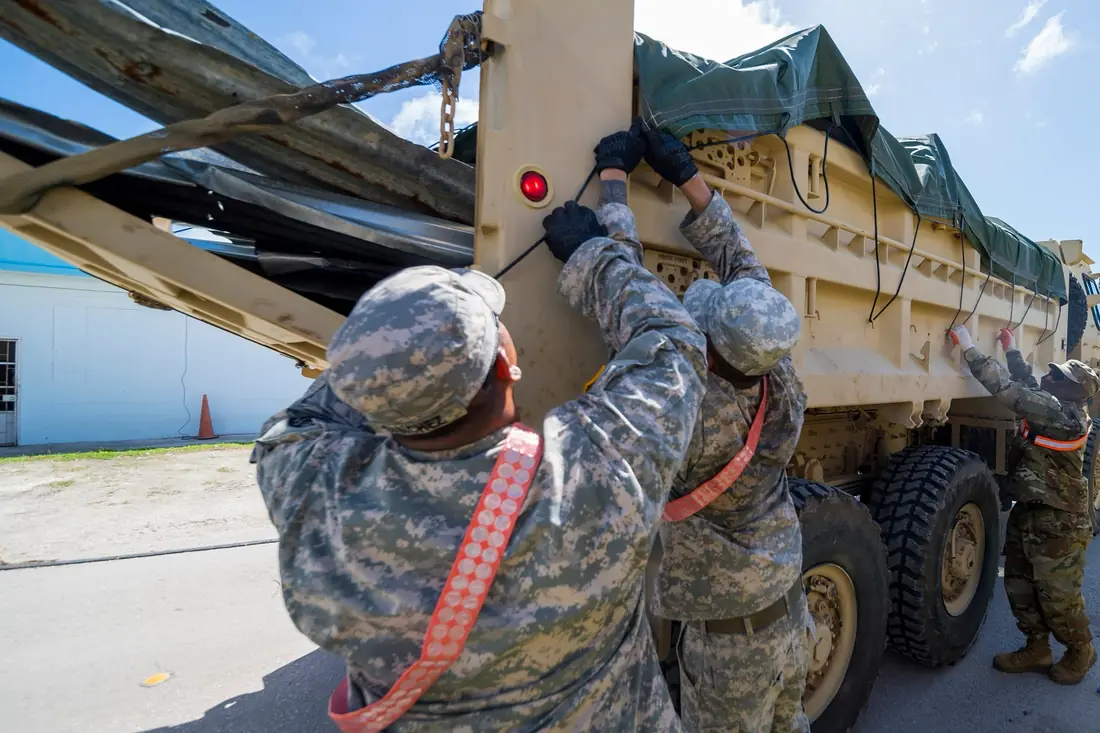
For commercial motor vehicles, FMCSA's cargo securement rule, 49 CFR 393.100(b), requires each vehicle carrying cargo on public roads to be loaded and secured "to prevent the cargo from leaking, spilling, blowing or falling from the motor vehicle." The federal rule doesn't say "tarp." It sets a result you must achieve, and for loose material, a cover is the practical way to achieve it. Whether a dump trailer combination counts as a commercial motor vehicle depends on its weight ratings and how it's used. See DOT Numbers, Inspections, and Registration for Dump Trailers.
State laws vary
Nearly every state has its own load-securement or "cover your load" law, and those usually apply to all drivers, commercial or not. A few examples show how different they are:
- Washington (RCW 46.61.655): Loads of dirt, sand, or gravel on paved public highways must be covered to prevent spillage. A cover isn't required if 6 inches of freeboard is maintained within the bed. The law also has criminal penalties when an unsecured load injures someone.
- California (Vehicle Code 23114): Aggregate loads can go uncovered only if the load stays 6 inches below the upper edge of the container where it touches the sides, front, and back, and doesn't peak above any part of the upper edge.
- Texas (Transportation Code 725.021): Loose-material loads must be covered and the cover secured at the front and back, unless the load is fully enclosed or doesn't blow or spill over the top. Commercial vehicles hauling loose material must cover or fully enclose the load.
Other states set different freeboard distances, cover rules for specific materials, or fines for uncovered loads. Many landfills and transfer stations also have their own rules for uncovered loads. Check your state's vehicle code and your local disposal sites.
Maintenance: keeping a tarp system working
Tarp systems fail gradually: a small rip that grows, a spring that loses tension, a motor connection that corrodes. Build these checks into your routine and your maintenance checklist:
Every use
- Look for tears, holes, and frayed edges. Patch small damage before wind turns it into a large rip.
- Watch the tarp roll. It should wind straight and tight. A tarp that tracks to one side wears its edges and bunches at one end of the roller.
- Make sure the rear secures. A loose rear edge flaps at highway speed and destroys tarps.
Monthly or seasonally
- Grease pivot points and check bushings at the arm pivots.
- Check arm alignment. Bent arms (often from a bucket or a low branch) twist the tarp and stress the springs.
- Check spring tension. Weak springs leave the tarp loose or short of the rear.
- On electric systems: clean and seal connections, check the breaker, and look for chafed wires at the pivots.
- Clean the tarp. Hose debris out of mesh. Check vinyl for stiffness and cracking after cold snaps.
- Check the housing for damage that could cut the tarp as it rolls.
Replacing a tarp
Order the right width and length for your box and system. Tarps that have to be stretched to fit wear faster, Pulltarps notes. Most kits use a pocket or a bolted strip at the roller and the front. Note how the old tarp was attached before you remove it.
The bottom line
A good dump trailer tarp system rolls straight, covers the whole box, and is easy enough to use that you actually use it on every load. Choose electric if you tarp often and manual if you don't. Mesh suits most dirt, gravel, and debris. Choose vinyl when the load has to stay dry and a heat-rated fabric for asphalt. Federal rules require commercial haulers to keep loads from blowing or spilling, and most states require covers or minimum freeboard for loose loads, with details that vary. Look up your state's rule, and keep the springs, pivots, and fabric in shape. For more on the trailer as a whole, see the dump trailer buying guide.
Frequently asked questions
Do I have to tarp my dump trailer?
Often, yes. Federal rules require commercial vehicles to prevent cargo from blowing or spilling, and most states have load-securement laws that apply to everyone. Some states let certain loads, such as gravel with enough freeboard, go uncovered. Rules vary, so check your state's vehicle code.
Is a mesh or vinyl tarp better for a dump trailer?
Mesh is the common choice for gravel, dirt, debris, and mulch. It's lighter, lets air through so it flaps less, and holds up to frequent use. Vinyl is better when the load must stay dry, such as sand for mortar, salt, or some landscape materials, but it can stiffen and crack in cold weather.
Is an electric tarp worth it on a dump trailer?
If you tarp several loads a day, usually yes. It saves time and strain and makes it more likely the load actually gets covered. For occasional use, a well-adjusted manual crank system is simpler and has fewer parts to fail.
How long does a dump trailer tarp last?
It depends on sun exposure, wind, how often it's used, and what you haul. Sharp or abrasive loads like rebar, broken concrete, and scrap wear tarps fastest. Inspect for tears and worn edges regularly and repair small damage early.
Share this guide
Link to this guide
Writing about dump trailers? You're welcome to quote this guide and link to it. Copy whichever format you need.
- URL
- https://stranktrailers.com/guides/dump-trailer-tarp-systems
- HTML link
- <a href="https://stranktrailers.com/guides/dump-trailer-tarp-systems">Dump Trailer Tarp Systems</a> (Strank Trailers)
- Citation
- Strank Trailers. "Dump Trailer Tarp Systems." stranktrailers.com, October 28, 2026. https://stranktrailers.com/guides/dump-trailer-tarp-systems
Keep reading
Specs · 9 min read
Dump Trailer Hydraulics, Pumps, and Batteries
How dump trailer hydraulics work: 12V pumps, single- vs. double-acting, fluid, deep-cycle batteries, 7-way and solar charging, remotes, and safety props.
Towing · 11 min read
DOT Numbers, Inspections, and Registration for Dump Trailers
Dump trailer DOT requirements explained: when you need a USDOT number, medical card, annual inspection, IFTA/IRP, and how trailer titles and plates work.
Ownership · 9 min read
Dump Trailer Maintenance Checklist
A dump trailer maintenance checklist with pre-trip, weekly, monthly, and annual tasks: lug nut torque, bearings, brakes, hydraulic fluid, grease points, rust.