
The Dump Trailer Buying Guide
A step-by-step dump trailer buying guide: use case, size, GVWR, hitch, hoist, gates, axles, tires, steel, coating, electrical, warranty and choosing a dealer.
By Strank Trailers12 min read
The short version
- Make decisions in order: job, payload, size, hitch, then build details. Most expensive mistakes come from picking a size before working out the weight.
- On most dump trailers, weight runs out before volume does. A 7x14 rated at 14,000 lb carries only about 3 to 4 cubic yards of gravel.
- Floor gauge, crossmember spacing, axle rating and hoist size are the specs that are hardest and most expensive to change later. Get them right at purchase.
- Read the warranty and the federal certification label (VIN plate). They tell you more than the brochure does.
- A dealer that stocks parts and does warranty work locally is worth real money over the life of the trailer.
On this page
- Step 1: What will you haul, and how often?
- Step 2: How much payload do you need? (GVWR)
- Step 3: What size dump trailer do you need?
- Step 4: Bumper pull or gooseneck?
- Step 5: Low-profile or deckover?
- Step 6: Which hoist?
- Step 7: Gates and ramps
- Step 8: Axles, suspension and brakes
- Step 9: Tires
- Step 10: Steel, frame and welds
- Step 11: Coating
- Step 12: Electrical, battery and hydraulics
- Step 13: Tarp system
- Step 14: Warranty
- Step 15: Choosing a dealer
- Step 16: New or used, and how to pay
- Dump trailer buying guide: quick decision checklist
- The bottom line
To buy the right dump trailer, decide in this order: the job, the payload, the size, the hitch, and then the build details (hoist, gates, axles, tires, steel, coating, electrical, warranty and dealer). Pick payload before size, because on most dump trailers weight runs out long before space does.
This dump trailer buying guide walks through each decision in that order. Each step links to a deeper article if you want the details.
Step 1: What will you haul, and how often?
Everything else follows from the job. Write down three things before you look at a single trailer:
- Your heaviest regular load. Rock, base, broken concrete, wet soil, shingles.
- Your bulkiest regular load. Brush, mulch, cleanout debris.
- How often you'll use it. A weekend homeowner, a landscaper loading daily, and a demolition crew dropping concrete from a loader bucket need very different trailers.
Use frequency decides how much build quality matters. A trailer that dumps twice a month can get by on lighter steel. One that's loaded by an excavator every day will find every weak weld and thin floor panel within a season. For job-specific advice, see best dump trailers for landscapers and best dump trailers for contractors.
Step 2: How much payload do you need? (GVWR)
GVWR (gross vehicle weight rating) is the most the trailer plus its load may weigh. Payload is GVWR minus the trailer's empty weight. Both numbers appear on the federal certification label, usually on the front of the trailer near the tongue. Full explanation: GVWR, payload and empty weight.
Common dump trailer GVWRs:
- 7,000 lb: 5x10 and 6x10 homeowner trailers on two 3,500 lb axles.
- 9,990 lb: a popular rating because it stays under 10,001 lb, the federal threshold where a trailer used in interstate commerce starts counting toward commercial motor vehicle rules. See DOT requirements for dump trailers.
- 14,000 lb: the contractor standard, on two 7,000 lb axles. Payload typically runs 9,000 to 10,500 lb.
- 15,400 to 17,600 lb: heavier springs, 8,000 lb axles, and often 17.5-inch tires.
- 20,000 to 30,000 lb: mega-duty tandems and tandem-dual goosenecks.
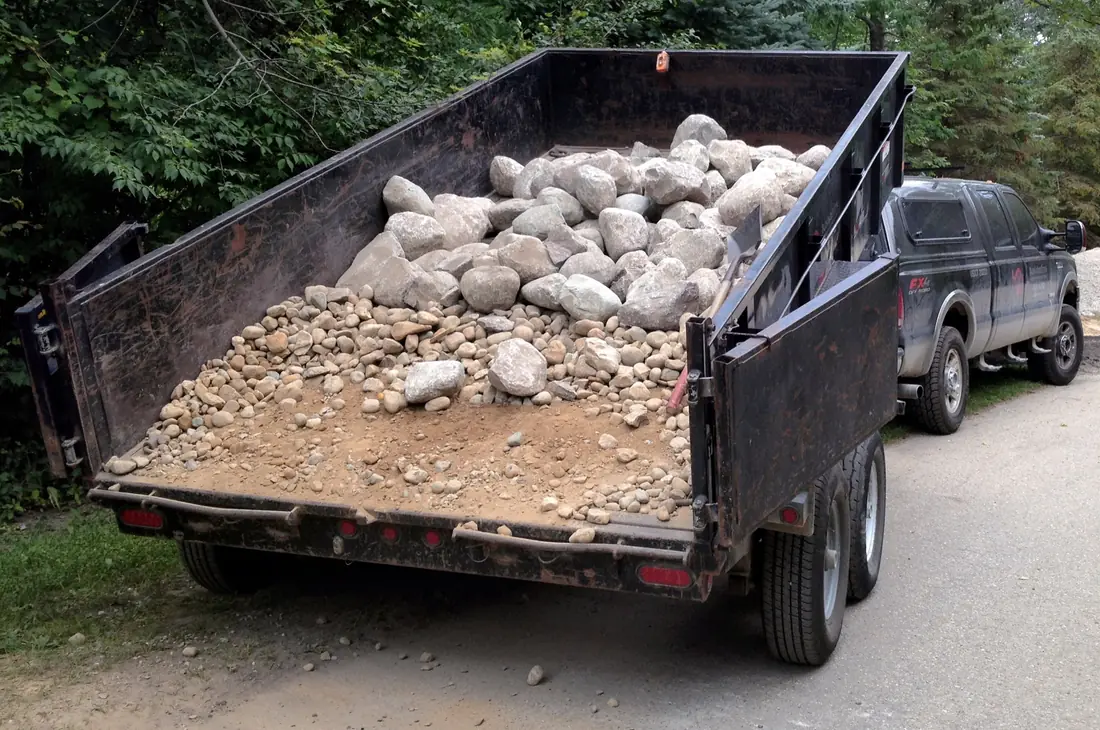
Here's the math most first-time buyers skip. Gravel and crushed stone commonly weigh about 2,500 to 3,000 lb per cubic yard. A 7x14 trailer rated at 14,000 lb that weighs 4,200 lb empty has about 9,800 lb of payload. That's roughly 3.5 cubic yards of gravel, which fills about half of a bed with 24-inch sides.
Check typical weights in the material weight chart, or plug in your trailer and material with the load calculator.
Step 3: What size dump trailer do you need?
Once you know your payload, choose a size for volume. Length also matters for maneuvering and for whether the trailer fits your yard and job sites. Detailed sizing: what size dump trailer do I need?
| Size (nominal) | Typical GVWR | Volume, 24" sides | Volume, 48" sides | Typical use |
|---|---|---|---|---|
| 5x10 | 7,000 lb | 3.7 cu yd | 7.4 cu yd | Homeowner, light yard work |
| 6x12 | 9,990–12,000 lb | 5.3 cu yd | 10.7 cu yd | Landscaping, small contractors |
| 7x14 (83") | 14,000–17,600 lb | 7.2 cu yd | 14.3 cu yd | General contracting, the most common size |
| 7x16 (83") | 14,000–22,000 lb | 8.2 cu yd | 16.4 cu yd | Heavy contracting, cleanouts |
| 8x20 (92–96") | 25,000 lb | 11–12 cu yd | 22–24 cu yd | High-volume hauling, usually gooseneck |
Volumes are calculated from nominal outside dimensions, so actual capacity is slightly less.
The pattern is the same at every size: tall sides are for light, bulky material. Four-foot sides on a 14,000 lb trailer don't add payload. They add room for mulch and debris, along with more wind drag and a higher center of gravity.
Step 4: Bumper pull or gooseneck?
A bumper pull couples to a ball on a receiver hitch at the truck's rear bumper. Plan on about 10 to 15% of the loaded trailer's weight sitting on the hitch. Bumper pulls are easier to hook up and work with more trucks.
A gooseneck couples to a ball in the truck bed, at or just ahead of the rear axle. It carries more weight on the truck (often around 15 to 25%), tracks more steadily at heavy weights, and turns tighter. Most dump trailers above about 17,500 lb are goosenecks. The trade-off is that a gooseneck ties up your truck bed and requires an in-bed hitch.
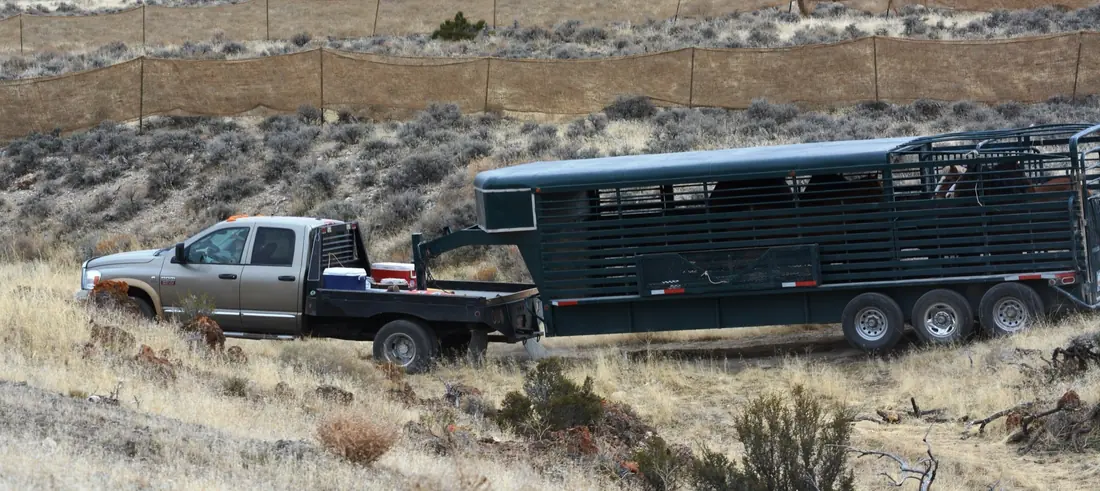

Compare them in detail in gooseneck vs. bumper pull dump trailers. Then check that your truck's tow rating, GCWR (gross combination weight rating), payload and rear axle rating all cover the loaded trailer: what truck you need for a dump trailer.
Your truck plus trailer also decides whether you need a CDL. A combination rated at 26,001 lb or more, towing a trailer rated over 10,000 lb, is a federal Group A vehicle. See CDL requirements for dump trailers.
Step 5: Low-profile or deckover?
A low-profile dump sets the bed between the wheels. Deck height is typically about 26 to 29 inches, and inside width is usually around 80 to 83 inches. It's easier to load by hand and has a lower center of gravity.
A deckover dump sets the bed above the wheels, for a full 96-inch width, often with fold-down sides. It's taller, but you can load pallets and equipment from the side.
Most contractors buy low-profile. Here's when a deckover makes sense: low-profile vs. deckover dump trailers.
Step 6: Which hoist?
The hoist is the hydraulic system that lifts the bed. There are three main designs:
- Scissor hoist: a folding linkage under the bed, pushed by one cylinder. It's compact and common on 10- to 16-foot beds.
- Telescopic hoist: a multi-stage cylinder mounted at the front of the bed. It's strong, and it handles heavy or front-loaded beds well.
- Dual-ram: two cylinders under the bed. It's simple and common on lighter trailers, where it's sometimes offered as an upgrade.
The design matters less than the sizing. Ask for the cylinder bore and stroke (for example, 6 by 21 inches) or the rated lift capacity, and compare it to the bed length and GVWR. Also ask whether the system is power-up/gravity-down or power-up/power-down. Power-down helps pull a stuck bed off its stops and keeps the gate from slamming. Full comparison: scissor vs. telescopic vs. dual-ram hoists.
Step 7: Gates and ramps
- Barn doors swing open full width for bulky debris and loading equipment.
- A spreader gate hinges at the top so material spreads in a controlled layer as you pull forward. This is essential for gravel driveways.
- A combo (2-way or 3-way) gate does both. It's the most common choice and worth having.
- Slide-in ramps store under the bed and let you load a mower or compact equipment.

If you load equipment, check ramp length and rating against the machine's weight. More detail: dump trailer gate options.
Step 8: Axles, suspension and brakes
Axle ratings should add up to at least the GVWR. Beyond that, look at:
- Hub lubrication. Grease-packed "easy lube" hubs need regular greasing and periodic repacking. Dexter calls for inspecting and repacking conventional bearings every 12 months or 12,000 miles. Oil-bath hubs let you check the oil level through a window and are common on 8,000 lb and heavier axles.
- Suspension. Multi-leaf slipper springs with equalizers are the dump trailer standard. Torsion axles ride smoother and have fewer wear parts, but they're harder to repair in the field.
- Brakes. Electric drum brakes on all axles are standard. Electric-over-hydraulic (EOH) disc brakes cost more and stop better, which is worth considering on heavy trailers. Every trailer should have a breakaway system. Federal rules for commercial vehicles require it to hold the brakes for at least 15 minutes.
Details: dump trailer axles and suspension and dump trailer brakes.
Step 9: Tires
Tires are the most commonly under-specced part of a dump trailer. Add up the load rating of all the tires and make sure it covers the GVWR with margin. For example, a common ST235/80R16 Load Range E (10-ply) tire is rated at 3,520 lb, and the 14-ply version at 4,080 lb.
Heavier trailers often step up to 17.5-inch tires with higher load ranges. Read the date code too. Trailer tires age out from sun and heat before they wear out. Full guide: dump trailer tires.
Step 10: Steel, frame and welds
This is where good and cheap trailers separate, and it's the hardest thing to fix later.
- Main frame. I-beam or heavy rectangular tube, typically 6 to 12 inches deep on heavy trailers. Deeper and heavier (more pounds per foot) is stiffer.
- Crossmembers. These are the cross pieces that support the floor. 16 inches on center is common on heavy-duty trailers, 12 inches is better for rock and point loads, and 24 inches is light-duty.
- Floor. 10-gauge (about 0.135 in) is standard on many trailers. 7-gauge (about 0.179 in, roughly 33% thicker) resists denting from rock, concrete and loader buckets. 12-gauge (about 0.105 in) belongs on homeowner trailers only.
- Sides and top rail. 10-gauge sides with formed or tube supports, and a tube top rail that doesn't flex when the tailgate slams.
- Welds. Look for continuous, even welds where crossmembers meet the frame and where the hoist mounts. Skip welds and stitch welds in high-stress areas are a warning sign.
Deeper reading: dump trailer steel gauge, frame construction and how to judge weld quality.
Step 11: Coating
- Paint is cheapest to apply and easiest to touch up, but chips readily.
- Powder coat is baked on and much tougher. Ask whether it goes over a primer and whether the steel is blasted or chemically prepped first. Prep matters as much as the powder.
- Galvanized steel is dipped in zinc and resists rust best, at a higher price. It's offered by a few builders on some dump models.
Wherever the floor meets the sides, water and grit collect, and that's where rust starts. Details: powder coat vs. paint vs. galvanized and rust prevention and storage.
Step 12: Electrical, battery and hydraulics
Many dump trailer "it won't lift" problems turn out to be electrical, so these details matter:
- A sealed wiring harness with LED lights, routed inside the frame or in conduit rather than zip-tied under the bed.
- A deep-cycle battery in a locking box, with a way to keep it charged: the 7-way charge line, an onboard 110V charger, a solar panel, or all three.
- A name-brand pump (KTI, Bucher and similar), with the fluid the pump maker specifies.
- A remote: a corded remote at minimum. Wireless is convenient, but keep the corded one as a backup.
See dump trailer hydraulics, pumps and batteries and dump trailer won't lift?
Step 13: Tarp system
Most states require loose loads to be covered or secured. A manual roll tarp costs a few hundred dollars and works fine. An electric tarp saves time and shoulders if you tarp many times a day. Look for a sturdy front shroud and arms that don't flex. More in dump trailer tarp systems.
Step 14: Warranty
Read the warranty itself, not the headline number. Among major brands in 2026, structural warranties range from 1 year to 6 years. Ask:
- What does "structural" cover? The frame only, or also crossmembers, the dump body and the hoist?
- Are hydraulics, electrical and paint covered, and for how long?
- Is coverage limited to the original owner? Is rental or fleet use excluded or shortened?
- Are axles, tires and pumps covered by their own makers instead?
- Who does the warranty work, and where?
Compare current warranty terms by brand in best heavy-duty dump trailers.
Step 15: Choosing a dealer
The trailer is half the purchase. The other half is who keeps it running. A good dealer:
- Stocks common parts: hoist cylinders, pumps, remotes, bearings, brake parts, lights.
- Does warranty work in-house, without making you haul the trailer to the factory.
- Does a pre-delivery inspection (PDI), checking lug torque, the brakes, the hoist cycle and the breakaway, and walks you through it.
- Will order the spec you want instead of pushing what's on the lot.
Ask how long warranty repairs typically take. A trailer down for three weeks waiting on a part costs a working business far more than the price gap between brands. That's the core argument in why cheap dump trailers cost more.
Step 16: New or used, and how to pay
A used trailer can be a good buy if the structure and hydraulics are sound. Use our used dump trailer inspection checklist and walk away from bent frames and cracked welds.
For budgeting, see how much a dump trailer costs. For loans, leases and the tax side, see financing a dump trailer. Don't forget registration, insurance and, for commercial use, DOT compliance: DOT numbers, inspections and registration.
Dump trailer buying guide: quick decision checklist
| Decision | Good default for most contractors | When to go heavier |
|---|---|---|
| GVWR | 14,000 lb | Rock, concrete or demolition at the limit daily: 16,000–17,600 lb |
| Size | 7x14 (83") with 24" sides | Bulky debris: 36–48" sides. Volume: 7x16 |
| Hitch | Bumper pull | Over about 16,000 lb, or long highway runs: gooseneck |
| Hoist | Scissor or telescopic, sized to the bed | Heavy daily loads: larger cylinder, power-down |
| Floor | 10 ga | Rock, concrete, loader buckets: 7 ga |
| Crossmembers | 16" on center | Point loads and rock: 12" on center |
| Axles | 2 x 7,000 lb, electric brakes | 8,000 lb oil-bath axles, 17.5" tires |
| Coating | Powder coat over primer | Coastal or salted roads: galvanized |
| Warranty | 3+ years structural, written | Longer terms that cover hoist and body |
The bottom line
Buy in order: job, payload, size, hitch, then build. Payload drives everything, and most dump trailers run out of weight before they run out of room. Spend your money on the parts that are hard to change later, like floor gauge, crossmember spacing, axles and hoist. Then buy from a dealer who will still answer the phone when something breaks.
Frequently asked questions
What should I look for when buying a dump trailer?
Start with GVWR and payload that match your heaviest regular load, then check the frame (main beam size and crossmember spacing), floor gauge, hoist type and size, axle and tire ratings, brakes on all axles, a sealed wiring harness, and the written structural warranty.
Is a 14,000 lb dump trailer big enough?
For most contractors and landscapers, yes. A 14,000 lb trailer typically carries 9,000 to 10,500 lb of payload. If you regularly haul rock, concrete or wet soil at that limit, step up to a 16,000 to 17,500 lb trailer with 8,000 lb axles.
Should I get a scissor hoist or a telescopic hoist?
Both work when properly sized. Scissor hoists are common and compact on 10- to 16-foot beds. Telescopic hoists mount at the front, lift with high force and handle heavy or uneven loads well. Dual-ram hoists use two cylinders under the bed. Size the hoist to the bed length and GVWR, whatever the style.
Do dump trailers need brakes on every axle?
Nearly every dump trailer comes with brakes on all axles. Federal rules for commercial vehicles require brakes on all wheels of most trailers, plus a breakaway system that holds the brakes for at least 15 minutes. State rules for non-commercial use vary, so check yours.
Is it better to buy a new or used dump trailer?
A used trailer can save thousands if the frame, floor, hoist and axles are sound. The risk is hidden damage: bent crossmembers, cracked welds, worn cylinders and corroded wiring. Inspect it carefully, or budget for repairs.
Share this guide
Link to this guide
Writing about dump trailers? You're welcome to quote this guide and link to it. Copy whichever format you need.
- URL
- https://stranktrailers.com/guides/dump-trailer-buying-guide
- HTML link
- <a href="https://stranktrailers.com/guides/dump-trailer-buying-guide">The Dump Trailer Buying Guide</a> (Strank Trailers)
- Citation
- Strank Trailers. "The Dump Trailer Buying Guide." stranktrailers.com, October 28, 2026. https://stranktrailers.com/guides/dump-trailer-buying-guide
Keep reading
Buying · 11 min read
Best Dump Trailers for Landscapers
The best dump trailers for landscaping: the size, side height, gate, ramp, tarp, and payload specs that matter, with representative models compared fairly.
Buying · 11 min read
Best Dump Trailers for Contractors and Construction
The best dump trailers for construction: GVWR from 14,000 to 30,000 lb, 7 gauge floors, I-beam frames, hoists, and goosenecks for demo, concrete, and rock.
Specs · 10 min read
GVWR, Payload, and Empty Weight Explained
GVWR is the most a loaded trailer may weigh. Payload is GVWR minus empty weight. How to read the label, find real payload, and check tongue weight and GCWR.