
Dump Trailer Safety: Dumping, Tipping, and Power Lines
Dump trailer safety: avoiding tip-overs when dumping, OSHA power line clearances, using the bed safety prop, sticky and frozen loads, chocks, and unhitching.
By Strank Trailers11 min read
The short version
- Dump only on firm, level ground with the trailer hooked to the truck. Side slope and soft ground are among the most common causes of tip-overs.
- Loads that stick at the front of a raised bed, like frozen, wet, or clay-heavy material, put the weight high and are a classic tip-over setup.
- OSHA's construction rule calls for at least 10 feet between equipment and power lines rated 50 kV or less, and more for higher voltages. If you don't know the voltage, keep 20 feet or more.
- The bed safety prop is for an empty bed only. Never get under a raised bed that isn't empty and resting on the prop.
- Keep everyone out of the dump zone, stay at the controls while the bed is up, and never jerk the bed or truck to free a stuck load.
On this page
Most serious dump trailer accidents happen in the few minutes the bed is raised. The trailer tips on uneven ground. A frozen or sticky load hangs up high. The bed contacts an overhead power line. Or someone is under the bed when it comes down. The basic rules: dump on firm, level ground with the trailer hooked to the truck. Check overhead before you raise the bed. Keep people out of the dump zone. Never go under a raised bed unless it's empty and resting on its safety prop.
This guide explains each hazard, the regulations that apply, and the habits that prevent accidents.
Why dump trailers tip over
A raised dump bed is a tall, heavy box balanced on a hinge and a cylinder. The trailer stays upright as long as the combined center of gravity of the bed and load stays between the frame rails. The Texas Department of Insurance's dump truck tip-over fact sheet puts it plainly: when the center of gravity isn't between the frame rails, the unit can tip.
Anything that shifts that center of gravity sideways or raises it can cause a tip-over.
| Cause | What happens | Prevention |
|---|---|---|
| Side slope | Raised bed leans; load slides to the low side | Dump only on level ground, side to side and front to back |
| Soft ground | One wheel sinks as the load shifts | Dump on compacted ground; avoid fresh fill and road shoulders |
| Load sticks at the front | Weight stays high in the raised bed | Lighten sticky loads; never dump frozen loads raised high |
| Uneven side-to-side loading | Bed is already off-center when it rises | Spread the load evenly before leaving the loading site |
| Gate fails to open | Load piles against the gate; the bed tries to lift the trailer | Unlatch the gates fully before raising |
| Uneven tire pressure or weak suspension | Trailer leans before the bed rises | Check pressures; fix sagging springs |
| High crosswind | Wind pushes on the raised bed | Don't dump tall beds in strong winds |
Level ground: side to side matters most
The industry-standard dump trailer owner's manual is explicit: raise the bed only if the truck and trailer are both on a firm, level surface, side to side and front to back. A slope you barely notice when parked looks very different with a loaded bed raised 45 degrees.
If you can't avoid a slope, the TDI fact sheet advises dumping with the slope, not against it. A slight front-to-back grade is far less dangerous than any side slope, which tilts the raised bed directly toward a rollover.
Sticky and frozen loads: the classic tip-over
The most dangerous dumps are the ones where the load doesn't flow. Wet clay, frozen dirt, and matted material can stick to the floor and the front wall. As the bed rises, the load stays near the top instead of sliding to the hinge, and the center of gravity climbs higher and higher. If it then breaks loose all at once, the sudden shift can rock the trailer over.
The TDI fact sheet lists material that doesn't flow and loads frozen to the box as tip-over causes. It also says not to leave loads in dump boxes overnight in winter. A Mine Safety and Health Administration safety alert describes a 2017 fatality: a tractor-trailer coal truck tipped over while dumping a load that was damp and frozen in the bed. As the bed rose, the trailer rocked and went over. MSHA also warns that a slight slope makes tipping more likely when material sticks at the top of the box.
What to do with a sticky load:
- Lighten it. Carry smaller loads of poorly flowing material, and keep weight out of the front of the box.
- Don't keep raising. If the load isn't moving by about halfway up, stop. Lower the bed.
- Free it with the bed down. The industry-standard manual says the proper procedure for a stuck load is to fully lower the bed and dislodge the material by hand. Never try to free a load from a raised bed.
- Don't shake it loose. Don't drive forward and stop hard to "shock" the load out, and don't jerk the up and down buttons. Both are on the industry manual's list of hazards.
- Prevent it. Empty the trailer at the end of the day in freezing weather. Some operators use release agents or bed liners so material slides more easily.
Raise in stages and drive ahead to spread
For spreading and for full loads, the industry manual describes raising the bed about halfway, or until the load starts to shift, then slowly driving forward to spread material before raising further. It also warns that fully raising a loaded bed can make the truck's rear wheels lose traction. A partly emptied bed raised higher is more stable than a full bed raised high.
Overhead power lines
Contact with an overhead line is one of the deadliest dump trailer accidents, and one of the easiest to prevent. A raised dump bed can reach well above the height of the truck, and electricity can arc to equipment that gets close without touching the line. The industry owner's manual warns that electrocution can occur without contact.
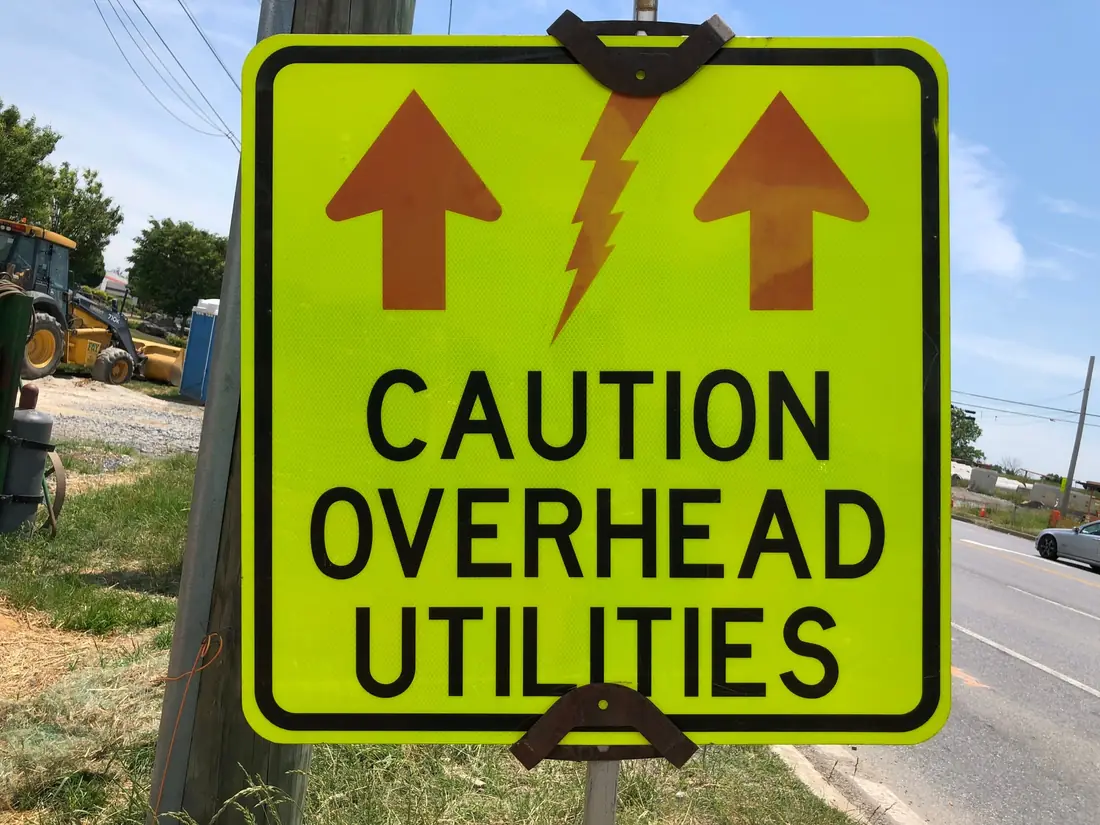

What OSHA requires
OSHA rules apply to employers and their workers. If you dump for a living, they apply to you. If you're a homeowner, the electricity works the same way, so treat these distances as the minimum.
- Construction equipment, 29 CFR 1926.600(a)(6): For lines rated 50 kV or below, keep at least 10 feet between the lines and any part of the equipment or load. Above 50 kV, keep 10 feet plus 0.4 inch for each kV over 50, or twice the length of the line insulator, but never less than 10 feet. In transit with no load and the bed down, the minimum is 4 feet for lines under 50 kV. When clearance is hard to judge, a designated person must watch and warn the operator.
- General industry, 29 CFR 1910.333(c)(3): Vehicles and mechanical equipment that can raise parts of their structure near energized overhead lines must keep 10 feet of clearance, plus 4 inches for every 10 kV over 50 kV.
- Cranes, 29 CFR 1926.1408: This rule doesn't cover dump trailers, but its approach is useful. Employers either keep 20 feet from lines up to 350 kV without confirming the voltage, or get the voltage from the utility and use the Table A distances below. Utilities such as FPL recommend the same 20-foot buffer for any equipment when the voltage is unknown.
| Line voltage | OSHA Table A minimum clearance (1926.1408) |
|---|---|
| Up to 50 kV | 10 ft |
| Over 50 to 200 kV | 15 ft |
| Over 200 to 350 kV | 20 ft |
| Over 350 to 500 kV | 25 ft |
| Over 500 to 750 kV | 35 ft |
You can't tell voltage by looking. Even neighborhood distribution lines can carry voltages that will kill instantly. In practice, look up before every dump. If there's any line nearby, move the trailer so the raised bed stays at least 20 feet away. Remember that lines sag in summer heat and sway in wind.
Before you dump near lines
- Look up before you back in, not after.
- Note the bed's raised height. A 14-foot dump trailer at full tilt reaches far higher than the truck cab.
- Watch for lines over driveways, at the edge of jobsites, and along rural roads.
- If clearance is tight, dump with the bed partway up, or move the drop location.
- Call the utility about de-energizing or covering lines if you'll be working near them regularly.
The bed safety prop
Every dump trailer should have a body prop (safety prop): a steel bar or stand that holds the raised bed mechanically, so you aren't relying on hydraulics while you work underneath.
The rules from the industry-standard owner's manual:
- The prop is designed to support an empty bed only. Never prop a loaded bed.
- Never enter the area under a raised bed unless the empty bed is resting on the prop.
- Park on firm, level ground. Raise the bed, set the prop upright, and lower the bed until the prop engages its receiver.
- Don't handle the prop while anyone is near the controls. Take the remote with you.
- On power-down systems, release the down button once the bed rests on the prop. Holding it can damage the trailer.
For dump trucks used in construction, OSHA requires the same thing in regulation. 29 CFR 1926.601(b)(10) requires trucks with dump bodies to have a permanently attached means of support that can be locked in place, to prevent accidental lowering during maintenance or inspection. OSHA's general equipment rule (1926.600(a)(3)) requires raised equipment to be blocked or cribbed before anyone works under it, and says dump bodies must be fully lowered or blocked when being repaired or not in use.
Keep people clear of the dump zone
The TDI fact sheet notes that many dump truck deaths happen to people near a bed that tipped, and that about 41% of dump truck-related deaths involve workers on foot. Treat the area around a raised bed as a no-go zone.
- Clear the area before raising the bed. That includes kids, pets, helpers, and homeowners.
- Run the controls from a position clear of the bed and its tip-over path, where you can see the whole trailer. Tethered remotes make this easier.
- Stay at the controls whenever the bed is up. The industry manual says never leave the scene with the bed raised.
- Don't dump beside another parked truck or trailer.
- Stand to the side when unlatching rear gates. The industry manual warns that material pressing against a spreader gate or barn doors can swing it open with force.
- Lower the bed fully before moving anything other than a slow forward spreading pass. Never drive with the bed up.
Chocks, parking brakes, and unhitching
Wheel chocks
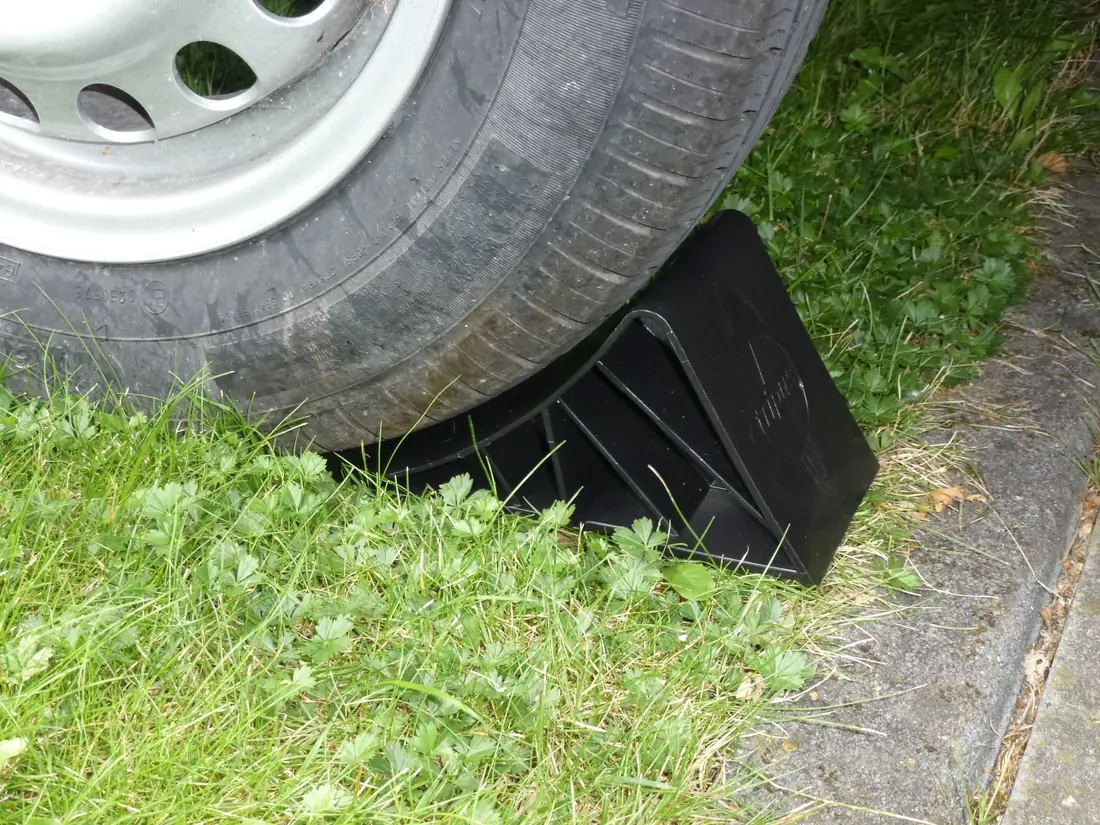
Set the truck's parking brake every time you stop to load or dump. On any incline, chock the trailer wheels too. OSHA's equipment rule requires chocks and a set parking brake for equipment parked on inclines. The industry owner's manual also has you block the trailer tires before uncoupling.

Dumping uncoupled: don't
The industry-standard manual states that the trailer must be coupled to the tow vehicle when unloading. An unhitched dump trailer resting on its tongue jack has a narrow, unstable footprint at the front. Raising the bed shifts weight rearward, and the tongue can lift or the jack can punch into the ground.
Unhooking a loaded trailer
Avoid unhooking a dump trailer with a load in it when you can. If you must:
- Use firm, level ground, and chock the wheels front and rear.
- Check that the jack is rated for the tongue weight. A loaded dump trailer can put a lot of weight on the jack, and on soft ground the foot can sink. A jack pad or wood block helps.
- Make sure the load sits forward of the axles. Weight behind the axles can lift the tongue once the hitch is released.
- Never raise the bed while the trailer is unhitched.
For more on weight placement, see how to load a dump trailer.
Don't defeat the hydraulic safety systems
The industry manual lists modifying dump controls or hydraulic components as a major hazard. An altered hydraulic system can malfunction and drop the bed without warning. Specifically:
- Never adjust the relief valve to lift a heavier load.
- Never help a struggling hoist with a jack, loader, or other machine.
- Never raise an overloaded bed. Unload it first.
- Lock or remove the remote when the trailer isn't in use, so kids or bystanders can't raise the bed.
If the bed won't lift, see dump trailer won't lift for safe troubleshooting.
Quick pre-dump safety checklist
- Truck and trailer coupled, parking brake set, chocks on any slope.
- Ground firm and level, side to side and front to back.
- Overhead clear: no lines within 20 feet of the raised bed's reach.
- Everyone out of the dump zone. You're at the controls with a clear view.
- Gates unlatched from the side and locked open, or spreader chains set.
- Raise in stages, and stop if the load isn't flowing.
- Stuck load? Lower fully and free it by hand. Never shake it loose.
- Bed fully down before driving away, and the remote stowed.
The bottom line
Dump trailer accidents happen while the bed is raised, and most are preventable. Dump only on firm, level ground with the trailer coupled. Lower the bed when a load sticks instead of raising it further, and keep at least 10 feet from power lines (20 feet if you don't know the voltage). Keep everyone clear, and never go under a raised bed that isn't empty and resting on its safety prop.
Frequently asked questions
Why do dump trailers tip over?
Tip-overs usually happen with the bed raised on uneven or soft ground, or when material sticks at the top of the bed instead of sliding out. Either one moves the center of gravity outside the trailer's frame rails. Overloading and uneven side-to-side loading make it worse.
How far should a dump trailer stay from power lines?
OSHA's construction equipment rule requires at least 10 feet of clearance from lines rated 50 kV or less, plus 0.4 inch for each kV above 50. You usually can't tell a line's voltage by looking, so many utilities advise 20 feet or more when the voltage is unknown. Check overhead before you raise the bed.
Can you unhook a loaded dump trailer?
It's best not to. A loaded trailer puts a heavy load on the tongue jack, and if the weight is behind the axles the tongue can lift once it's unhooked. Never raise the bed on an unhooked trailer. Owner's manuals say the trailer must be coupled to the tow vehicle when dumping.
Can I use the safety prop with a loaded bed?
No. Owner's manuals state that the body prop is designed to support an empty bed only. Unload the bed completely before raising it onto the prop to work underneath.
Share this guide
Link to this guide
Writing about dump trailers? You're welcome to quote this guide and link to it. Copy whichever format you need.
- URL
- https://stranktrailers.com/guides/dump-trailer-safety
- HTML link
- <a href="https://stranktrailers.com/guides/dump-trailer-safety">Dump Trailer Safety: Dumping, Tipping, and Power Lines</a> (Strank Trailers)
- Citation
- Strank Trailers. "Dump Trailer Safety: Dumping, Tipping, and Power Lines." stranktrailers.com, October 28, 2026. https://stranktrailers.com/guides/dump-trailer-safety
Keep reading
Specs · 9 min read
Scissor Hoist vs. Telescopic vs. Dual-Ram Dump Trailers
Scissor hoist vs. telescopic vs. dual-ram dump trailers: how each works, dump angle, lifting capacity, stability, maintenance, cost, and which fits your loads.
Ownership · 9 min read
How to Load a Dump Trailer
How to load a dump trailer safely: tongue weight targets, front-to-back placement, loading with a skid steer or excavator, material weights, GVWR, and tarping.
Ownership · 10 min read
Dump Trailer Won't Lift? Hydraulic Troubleshooting
Dump trailer won't lift? Diagnose it step by step: battery voltage, ground, solenoid, low fluid, overload, air, stuck valves, cold fluid, and cylinder leaks.