
Scissor Hoist vs. Telescopic vs. Dual-Ram Dump Trailers
Scissor hoist vs. telescopic vs. dual-ram dump trailers: how each works, dump angle, lifting capacity, stability, maintenance, cost, and which fits your loads.
By Strank Trailers9 min read
The short version
- A scissor hoist uses one short cylinder and a folding linkage under the middle of the bed. A telescopic hoist uses one multi-stage cylinder at the front. A dual-ram hoist uses two straight cylinders under the bed.
- Front-mounted telescopic cylinders get the most leverage. In a simple example, they need about half the starting force of a cylinder mounted mid-bed.
- Scissor hoists brace the bed side to side and are the most common, lowest-cost choice on 7k to 20k bumper-pull dump trailers.
- Most dump bodies are designed to dump at about 45 to 50 degrees. Steeper angles help sticky loads but reduce capacity and raise the tipping risk.
- Most dump trailer hoists are single-acting: hydraulic pressure lifts the bed and its own weight lowers it.
On this page
- Scissor vs. telescopic vs. dual-ram at a glance
- How a scissor hoist works
- How a telescopic hoist works
- How dual-ram (and single straight-ram) hoists work
- Single-acting vs. double-acting cylinders
- Dump angle: how steep is steep enough?
- Lifting capacity: what the number really means
- Stability: side loads and tipping
- Maintenance compared
- Which hoist suits which loads?
- The bottom line
A scissor hoist uses one short hydraulic cylinder and a folding steel linkage under the middle of the bed. A telescopic hoist uses one multi-stage cylinder mounted at the front of the bed. A dual-ram hoist uses two straight cylinders, usually mounted mid-bed. Telescopic cylinders give the most leverage and usually the highest capacity. Scissor hoists are the common, cost-effective choice on 7k to 20k bumper pulls and brace the bed well side to side. Dual-ram setups are mostly found on lighter trailers.
The right choice depends on what you haul, how heavy it is, and where you dump it.
Scissor vs. telescopic vs. dual-ram at a glance
| Scissor | Telescopic | Dual-ram | |
|---|---|---|---|
| Where it mounts | Under the bed, mid-length | Front of the bed | Under the bed, mid-length |
| Leverage at start of lift | Good, from the linkage | Highest | Lowest |
| Side-to-side bracing | Good; the linkage braces the bed | Low; relies on hinge and frame | Depends on the cylinders staying in sync |
| Moving parts | One cylinder plus linkage pivots | One cylinder with several stages | Two cylinders |
| Relative cost | Lower | Higher | Varies; often lower |
| Best fit | General landscaping and contracting, 7k–20k | Heavy, dense loads; 14k and up; goosenecks | Light-duty trailers, even loads |
How a scissor hoist works
A scissor hoist has a short cylinder lying nearly flat under the bed. When it extends, it pushes a set of hinged arms that open like a pair of scissors. The linkage turns a short cylinder stroke into a tall lift.
PJ's DL, for example, lists a 5 x 17 in cylinder with scissor (5 x 21 in on the 16 ft model). Load Trail's DT series lists a 5 x 15.75 in cylinder with scissor. Big Tex's 14LP, 16LP, and 20LP all use a self-contained scissor hoist.
Strengths:
- Side-to-side bracing. The linkage is pinned at several points to both the main frame and the bed, so it helps keep the raised bed from rocking or twisting on slightly uneven ground.
- Doesn't take bed space. Everything sits under the floor, so you get the full box length.
- Lower cost. Scissor trailers are generally less expensive than comparable telescopic trailers.
Weaknesses:
- More pivots to maintain. Each pin and bushing in the linkage needs grease and eventually wears. Worn pivots show up as slop or clunking during a lift.
- Hardest work at the start. The linkage starts nearly flat, which is when the load is heaviest and the geometry is least favorable. Builders size the cylinder for this, but it's part of why scissor hoists top out at lower capacities than big telescopics.
- Concentrated mounting loads. The hoist pushes on the frame and bed at a few specific points, so those mounts and their welds need to be well built.
How a telescopic hoist works
A telescopic cylinder is a set of nested steel tubes, called stages, that slide out of each other like a spyglass. A 3-stage, 4-stage, or 5-stage cylinder can collapse short enough to fit at the front of a low-profile trailer and still extend far enough to tip the bed steeply.
Diamond C's LPT uses a 3-stage telescopic cylinder (5-stage optional) with a published 45-degree dump angle. Texas Pride lists a 4-stage telescopic on its 16K dump.
Why front mounting gives more leverage
The farther the cylinder pushes from the rear hinge, the less force it needs. Custom Hoists, a cylinder manufacturer, gives the basic relationship: starting cylinder force is roughly the load times its distance from the hinge, divided by the cylinder's distance from the hinge.
Here's a simplified example on a 14 ft bed with the load centered about 7 ft (84 in) from the rear hinge. It ignores the cylinder's angle and the weight of the body itself.
| Cylinder position | Distance from hinge | Starting force needed |
|---|---|---|
| Front of bed (telescopic) | about 160 in | about 53% of the load |
| Mid-bed (straight ram) | about 84 in | about 100% of the load |
That's the core advantage of a front-mounted telescopic: about twice the leverage of a cylinder mounted mid-bed. It's a big reason front-mount telescopics are so common on heavy dump trucks and end-dump semi-trailers.
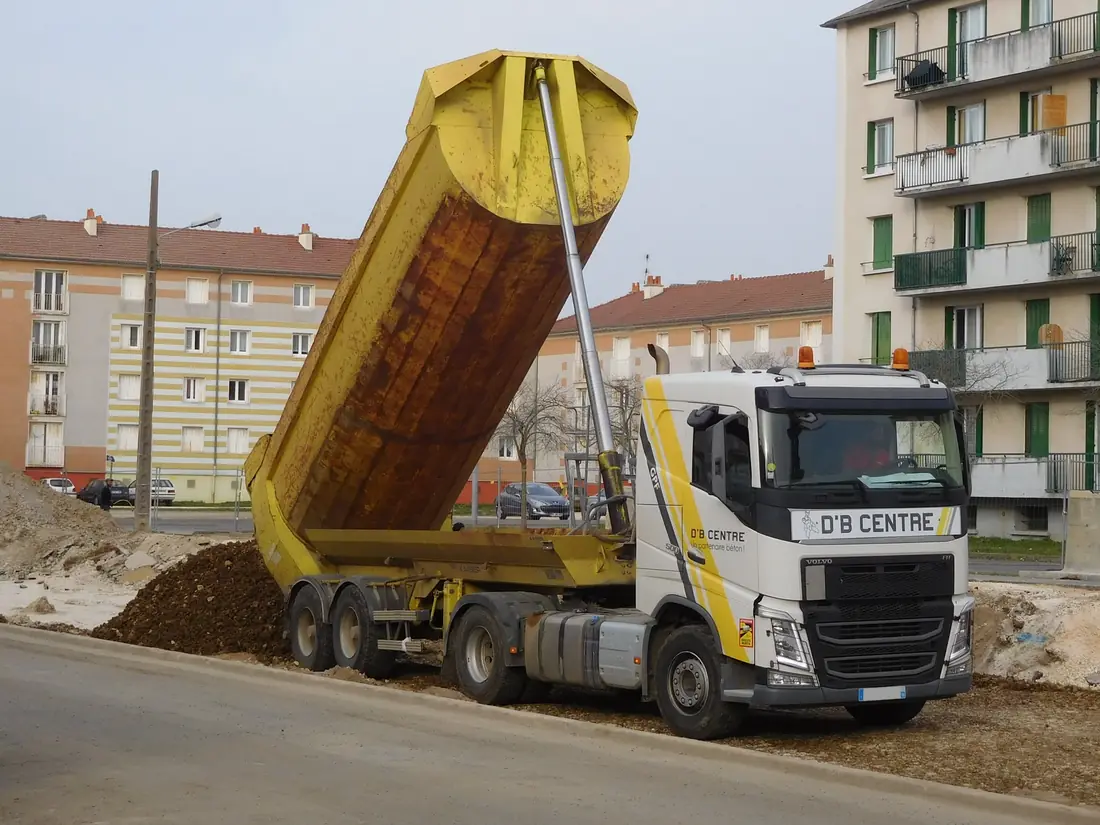

As the bed rises and material slides toward the gate, the load moves closer to the hinge, so later stages can be smaller and still finish the lift.
Strengths:
- More lifting capacity for heavy, dense loads like wet sand, gravel, and rock.
- Fewer pivots. One cylinder with two mounting pins means fewer wear points than a scissor linkage, though the cylinder itself has more seals.
- Even force on the bed. The push comes from the front and spreads the load along the bed frame.
Weaknesses:
- Little side-to-side support. Quoted in a Trailer/Body Builders article, Stephen Vezina of Mailhot Industries, a cylinder maker, put it plainly: "A telescopic cylinder is not a structural support designed to prevent side movements." A raised telescopic bed relies on the hinge and bed frame to stay upright.
- Higher cost. Telescopic packages usually cost more than comparable scissor trailers.
- Takes space at the front. The cylinder needs room ahead of or inside the front of the box.
How dual-ram (and single straight-ram) hoists work
A dual-ram hoist uses two straight cylinders mounted under the bed, usually one on each side of center. A single straight-ram hoist uses one. Both push the bed up directly with no linkage. Big Tex's 90SR, for example, uses a single straight ram with a published 43-degree dump angle.
Strengths:
- Simple design with off-the-shelf cylinders that are relatively cheap to replace.
- Two lift points can spread force across the bed.
Weaknesses:
- Lower leverage. Mounted mid-bed, the cylinders need roughly the full load's worth of starting force, as the table above shows.
- Sync problems. With an uneven load, two cylinders on a shared hydraulic circuit can extend at different rates. That twists the bed and strains the hinge and frame.
- Usually a lower maximum dump angle than a telescopic, because straight cylinders have limited stroke.
You'll mostly see straight-ram and dual-ram hoists on lighter trailers.
Single-acting vs. double-acting cylinders
Most dump trailer cylinders are single-acting: hydraulic pressure extends the cylinder, and the weight of the bed pushes the fluid back out to lower it. That's what "power up, gravity down" means.
A double-acting cylinder has fluid ports on both sides of the piston, so the pump can push it both up and down. Some systems are labeled "power up/power down." PJ and Big Tex, for example, list "power up/power down and gravity down" pumps on their scissor trailers, and Diamond C lists a power-up/gravity-down unit on its telescopic LPT.
What it means for you:
- With gravity-down, an empty bed can lower slowly, especially in cold weather when the oil is thick. That's normal.
- Power-down helps pull a bed down when it doesn't want to come down by itself. It doesn't make a stuck or hung-up load safe.
- Either way, the cylinder only lifts. If the load hangs up at the top, the bed is at its least stable point.
Pumps, batteries, and valves are a big part of hoist reliability. See dump trailer hydraulics, pumps, and batteries, and if your bed won't move, try dump trailer won't lift.
Dump angle: how steep is steep enough?
Most dump bodies are designed to dump at about 45 to 50 degrees. Custom Hoists lists 45 degrees as a normal minimum and 57 degrees as a normal maximum. In the Trailer/Body Builders article, Vezina recommended 50 to 53 degrees fully extended and warned that going past 60 degrees creates unsafe conditions.
Published angles on dump trailers vary by model. Diamond C lists 45 degrees on the telescopic LPT. Big Tex lists 43 degrees on the straight-ram 90SR. Some dealers advertise scissor trailers at up to 47 degrees.
The trade-offs:
- Steeper angles help wet clay, compacted soil, and other sticky loads slide out.
- Steeper angles usually mean lower rated capacity. Getting more stroke out of a given cylinder means mounting it closer to the hinge, and that costs leverage.
- Steeper angles raise the center of gravity of whatever is still in the bed, which raises the tipping risk.
A few degrees on the spec sheet matter less than dumping on level ground and keeping the load from hanging up.
Lifting capacity: what the number really means
Hoist capacity depends on three things: the cylinder's bore (diameter), the hydraulic pressure, and the geometry. Force is pressure times area. A 5 in bore has about 19.6 square inches of area, so at 2,000 psi it pushes with about 39,000 lb. How much of that turns into lift depends on where and at what angle the cylinder pushes.
When you compare capacities:
- Ask what load distribution the rating assumes. Ratings usually assume the load is spread evenly. A pile against the front wall or one side is harder to lift.
- Ask whether the rating is at the start of the lift or across the full range.
- Make sure the hoist is rated for the trailer's full payload, not just the typical load.
Stability: side loads and tipping
A raised dump bed is a tall, heavy object balanced on a hinge and a cylinder. Every hoist type can tip.
Scissor linkages add some side-to-side bracing. Telescopic cylinders add almost none. Dual rams can make things worse if they extend unevenly. Hinge spacing and bed frame stiffness matter on every type. See dump trailer frame construction for what a strong hinge and bed frame look like.
Maintenance compared
| Task | Scissor | Telescopic | Dual-ram |
|---|---|---|---|
| Grease pivots and pins | Linkage pivots plus cylinder pins; most points | Top and bottom cylinder pins | Cylinder pins on both rams |
| Inspect cylinder | One cylinder: rod, seals, leaks | Each stage: scoring, pitting, leaks, dents | Two cylinders: rods, seals, leaks |
| Check for wear | Linkage pins and bushings for slop | Stage seals for drift | Even extension on both sides |
| Common shared items | Fluid level, hoses, pump, battery | Same | Same |
Keep the cylinder rod clean. A dented or pitted rod or stage will cut the seals, and a leaking cylinder will let the bed drift down.
Which hoist suits which loads?
| Work | Good fit | Why |
|---|---|---|
| Mulch, brush, yard waste | Scissor or dual-ram | Light loads; low cost matters |
| Topsoil, gravel, general contracting on a 14k | Scissor | Proven, braces the bed, lower cost |
| Wet sand, rock, concrete, heavy demolition | Telescopic | Most leverage for dense loads |
| Goosenecks and 20k+ trailers | Telescopic, or a heavy scissor rated for the payload | Capacity |
| Frequent dumping on less-than-perfect ground | Scissor | Better side bracing (still dump level) |
The bottom line
Telescopic hoists give the most leverage and capacity, scissor hoists give good side bracing at a lower price, and dual-ram setups are mostly a light-duty solution. For most 14k bumper-pull work, a well-built scissor hoist is enough. For dense, heavy loads near full payload, the telescopic's leverage is worth paying for. Whatever you choose, check the cylinder size, the mounts, and the welds, and always dump on level ground.
Frequently asked questions
Is a scissor hoist or telescopic hoist better on a dump trailer?
Neither is better for every job. Telescopic hoists offer more leverage and higher capacity for heavy, dense loads. Scissor hoists cost less, brace the bed well side to side, and handle most landscaping and contracting work on 14k trailers.
What dump angle does a dump trailer need?
About 45 to 50 degrees clears most materials. Wet clay and other sticky loads benefit from the high end of that range. Published angles vary by model, so check the spec sheet.
Are dual-ram dump trailers any good?
They can work well on lighter trailers with evenly spread loads. Two mid-mounted cylinders have less leverage than a front telescopic, and if they extend unevenly they can twist the bed, so they're less common on heavy-duty trailers.
What does single-acting cylinder mean?
A single-acting cylinder uses hydraulic pressure to extend only. The bed comes down under its own weight as fluid returns to the reservoir through a valve, which is often called power up, gravity down.
Do telescopic dump trailers tip over more easily?
A telescopic cylinder isn't designed to resist sideways loads, so a raised telescopic bed depends on the hinge and frame for side-to-side stability. Any dump trailer can tip if you dump on uneven ground or the load hangs up on one side.
Share this guide
Link to this guide
Writing about dump trailers? You're welcome to quote this guide and link to it. Copy whichever format you need.
- URL
- https://stranktrailers.com/guides/scissor-hoist-vs-telescopic-hoist
- HTML link
- <a href="https://stranktrailers.com/guides/scissor-hoist-vs-telescopic-hoist">Scissor Hoist vs. Telescopic vs. Dual-Ram Dump Trailers</a> (Strank Trailers)
- Citation
- Strank Trailers. "Scissor Hoist vs. Telescopic vs. Dual-Ram Dump Trailers." stranktrailers.com, October 28, 2026. https://stranktrailers.com/guides/scissor-hoist-vs-telescopic-hoist
Keep reading
Specs · 9 min read
Dump Trailer Hydraulics, Pumps, and Batteries
How dump trailer hydraulics work: 12V pumps, single- vs. double-acting, fluid, deep-cycle batteries, 7-way and solar charging, remotes, and safety props.
Ownership · 10 min read
Dump Trailer Won't Lift? Hydraulic Troubleshooting
Dump trailer won't lift? Diagnose it step by step: battery voltage, ground, solenoid, low fluid, overload, air, stuck valves, cold fluid, and cylinder leaks.
Ownership · 11 min read
Dump Trailer Safety: Dumping, Tipping, and Power Lines
Dump trailer safety: avoiding tip-overs when dumping, OSHA power line clearances, using the bed safety prop, sticky and frozen loads, chocks, and unhitching.