
Dump Trailer Won't Lift? Hydraulic Troubleshooting
Dump trailer won't lift? Diagnose it step by step: battery voltage, ground, solenoid, low fluid, overload, air, stuck valves, cold fluid, and cylinder leaks.
By Strank Trailers10 min read
The short version
- Most dump trailers that won't lift have a battery or ground problem. Check voltage first, under load if you can.
- If the pump motor runs but the bed doesn't move, suspect low fluid, an overload hitting the relief valve, a stuck valve, or a cylinder leaking internally.
- A click with no motor usually means low voltage, a bad ground, or a failed start solenoid. No click at all points to the remote, its plug, or the control circuit.
- Never adjust the relief valve to lift a heavier load. Pump makers warn it can cause catastrophic failure, and it won't increase speed.
- Never go under a raised bed unless it's empty and resting on the safety prop.
On this page
When a dump trailer won't lift, the cause is usually electrical, not hydraulic. A weak battery, a corroded ground, or a bad connection at the remote accounts for most no-lift calls. Start with the battery and work outward toward the cylinder. Use the sound the pump makes to narrow it down. Silence, a click, a slow groan, and a motor that runs freely with no lift each point to different causes.
This guide covers single-acting (power up, gravity down) and double-acting (power up, power down) 12-volt units, which is what most bumper-pull and gooseneck dump trailers use.
First: what does it sound like?
| What you hear | What it usually means | Go to |
|---|---|---|
| Nothing at all | No signal reaching the solenoid: remote, plug, fuse, or dead battery | Battery, remote |
| Click, no motor | Solenoid gets a signal, but the motor doesn't get enough current | Battery, ground, solenoid |
| Motor runs slowly or bogs | Low voltage, undersized cables, cold fluid, or an overload | Battery, cold, overload |
| Motor runs normally, bed doesn't move | Fluid isn't reaching the cylinder: low fluid, stuck valve, lost prime, relief bypassing | Fluid, valves, overload |
| Bed lifts partway, then stops | Fluid runs out, the load is too heavy, or the battery is fading | Fluid, overload, battery |
| Bed lifts empty but not loaded | Overload or a weak relief valve | Overload |
Step 1: Check battery voltage
The pump motor draws a lot of current. Batteries that start a truck fine can still fall short here, because most dump trailer batteries get recharged slowly through the truck's 7-way plug, or not at all.
- Check resting voltage with a multimeter at the battery posts. A charged 12-volt lead-acid battery reads about 12.6–12.8 V after resting. At 12.2 V it's about half charged. Below 12.0 V, charge it before you troubleshoot anything else.
- Check voltage under load. Have a helper hold the "up" button while you watch the meter. If voltage collapses far below 10 V, the battery can't deliver the current. For reference, the standard automotive load test expects a healthy battery to hold at least 9.6 V for 15 seconds at half its cold-cranking-amp rating, at about 70°F.
- Load test or swap. An auto parts store can load-test the battery. Or jump it from your truck with heavy cables. If the bed lifts on a jump, you've found the problem.
The industry owner's manual points out another symptom of a weak battery: if the pump loses pressure, fluid can run back into the reservoir, overfill it, and spray out into the battery box. Fluid in the battery box often means a low battery, not a leak.
Step 2: Check the ground and the cables
A bad ground acts exactly like a bad battery.
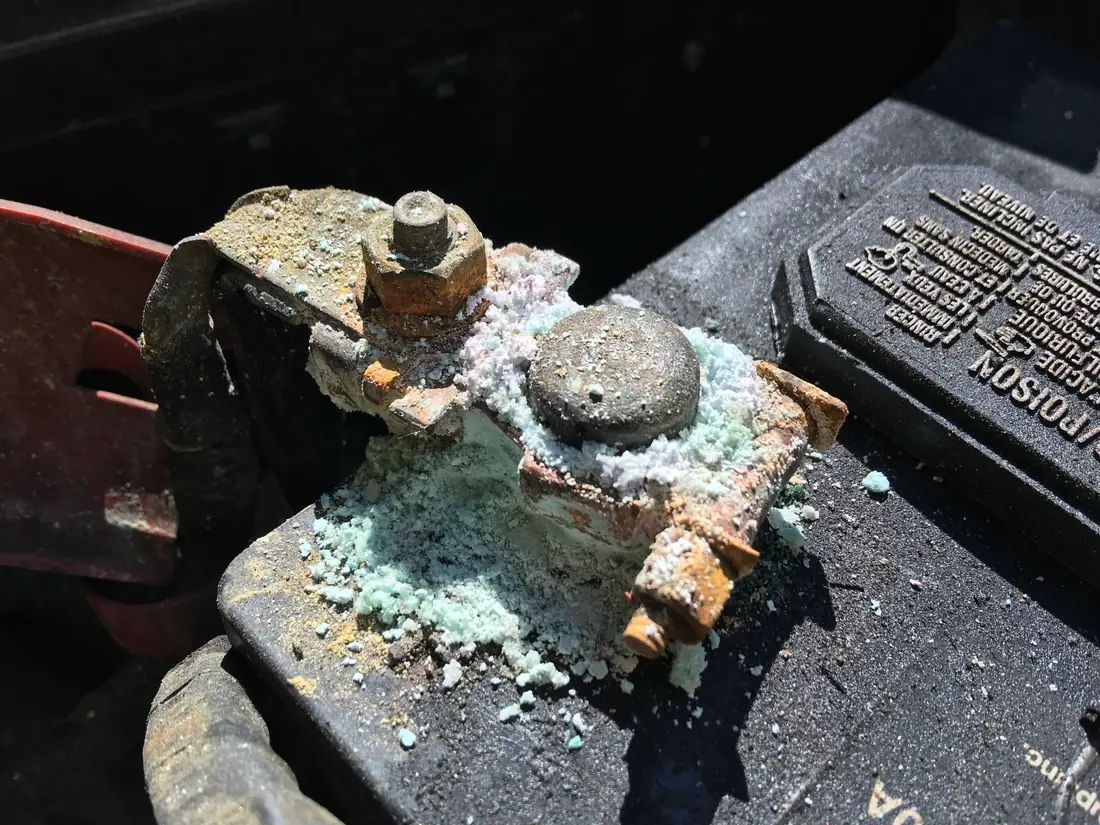

- Clean the connections. Remove the battery terminals, the ground at the motor or frame, and the cable at the solenoid. Clean to bright metal and reinstall tight. A thin coat of dielectric grease afterward slows corrosion.
- Jump the ground only. DLH Fluid Power's troubleshooting chart suggests running a jumper cable from the battery negative directly to the motor case (or to the ground stud on two-terminal motors). If the pump comes alive, repair the ground path.
- Check cable size. Pump makers publish cable charts based on run length. KTI's chart calls for 4-gauge on a 1–2 ft run and 2/0 at 10–12 ft. A gooseneck with the battery far from the pump needs heavy cable. KTI notes that low voltage makes the motor draw more amps, which damages other electrical parts.
Step 3: The solenoid click
The start solenoid is a heavy-duty relay. The small current from your remote closes it, and it passes the big current to the motor.
- No click: The solenoid isn't getting a signal. Check the remote's plug and pins, the fuse or breaker if there is one, and the wire from the remote to the solenoid. DLH recommends cleaning dirty contacts inside the remote with a pencil eraser. They warn that abrasives cause repeat failures.
- Click but no motor: The solenoid closes, but current isn't flowing. That's either low voltage or burned solenoid contacts. With the battery confirmed good, briefly bridge the two large solenoid posts with an insulated jumper or a heavy screwdriver. Stand clear, wear eye protection, and expect a spark. If the motor runs, replace the solenoid. If the motor still doesn't run with a good battery bridged straight to it, the motor itself is the problem. DLH lists rust inside the DC motor as a cause.
Step 4: Motor runs, bed doesn't lift
If the motor sounds healthy but nothing moves, the pump is turning but pressure isn't reaching the cylinder.
Low hydraulic fluid
Check the level with the bed fully down, so all the cylinder's fluid is back in the reservoir. The industry-standard manual says to fill to the full mark on the reservoir. If you overfill with the bed raised, fluid will overflow when the bed comes down.
If it's low, find out why. Look for wet hose ends, wet fittings, or a wet cylinder.
What fluid to use depends on your pump. KTI recommends premium anti-wear hydraulic oil (ISO 22–68 range) and accepts Dexron III ATF under normal conditions. DLH recommends ISO 22–46 with anti-wear additives, and ATF Dexron III for colder climates. Both say don't mix fluid types, and both warn against biodegradable fluids with standard Buna seals.
Overloaded bed hitting the relief valve
Every pump has a pressure relief valve. When the load needs more pressure than the valve allows, the valve opens and sends fluid back to the tank. The motor runs, often with a strained whine, and the bed doesn't move or stops partway. That's the system protecting itself.
- If the bed lifts empty but not loaded, you're probably overloaded or the material is stuck at the front.
- Do not try to raise an overloaded bed. The industry-standard owner's manual says to remove excess material by hand or with equipment.
- Do not adjust the relief valve to force a lift. DLH warns that tampering can cause catastrophic failure, and that adjusting it won't increase flow or speed. Raising the relief pressure pushes the cylinder, hoses, and hinge beyond what they were designed for.
- Never help the hoist with a jack, a loader, or another machine. The industry manual says this in capital letters.
For how to load within limits, see how to load a dump trailer.
Stuck or dirty valve
Double-acting units use a solenoid-operated directional valve. Many units also have a load-holding valve, and some have a flow-control valve. Debris or a bent valve stem can keep them from shifting.
- Tap test: Lightly tap the valve body or solenoid coil with a wrench handle while a helper presses "up". If it starts working, plan to clean or replace that valve.
- Coil check: Make sure the valve coil gets power. A screwdriver tip held near an energized coil will feel the magnetic pull.
- Only one coil at a time: On some double-acting remotes, a failed diode energizes both coils at once. DLH's chart says to unplug a coil and test. Only one should operate per button.
- Pull and inspect only with the bed fully down or resting on its prop, and the system depressurized. DLH notes that some valves sit below fluid level and will partially drain the tank when removed.
Lost prime or air in the system
A pump that sucked air, perhaps after running low, after a hose change, or on a new install, may not pick up fluid. Air also makes lifts jerky or spongy.
KTI's bleed procedure works on most units:
- Fill the reservoir.
- Raise the bed about one-third of the way, then lower it fully.
- Raise it about two-thirds, then lower it.
- Raise it fully, then lower it.
- Let the fluid settle, check for foam through the breather opening, and repeat if needed. Don't let the level drop below half during the process.
- Top off to the full line with the bed down.
If the pump won't prime at all, DLH suggests removing the check valve plug and briefly running the motor to prime it.
Step 5: Cold weather
Cold slows a dump trailer down in two ways. Hydraulic fluid thickens, so the pump works harder. Battery output drops at the same moment the motor needs more current. A system that's marginal in July can stall in January.
- Keep the battery fully charged. A discharged lead-acid battery can also freeze and crack. The industry-standard manual warns about this for storage.
- Use the right fluid for your climate. KTI's chart lists ISO 22, ISO 32, or Dexron III ATF from 14°F to 120°F, and lighter ISO 15 below that. For prolonged extreme cold it accepts aviation hydraulic oils. Drain and refill when switching types. Don't blend.
- Warm it up. Cycle the bed up a few inches and back down a few times before you try a full lift.
- Frozen loads: Wet material can freeze to the floor and sides, especially at the front. A pump that "won't lift" may be fighting a load frozen in place. That's also a tip-over risk, covered in dump trailer safety.
Step 6: Cylinder leaks
Cylinders leak in two ways.
- External leak: You'll see fluid on the cylinder body, at the gland where the rod exits, or dripping from the base. Seals or the cylinder need service. On telescopic cylinders, look at each stage.
- Internal leak (bypass): Fluid slips past the piston seals inside. The pump runs and the bed barely moves, or the raised bed slowly drifts down. DLH's chart lists fluid passing through the cylinder without moving the rod, or coming out the rod-end vent, as reasons to rebuild or replace it.
A scored or bent rod will keep eating new seals, so inspect the rod whenever you have seals replaced. Cylinder rebuilds are usually a job for a hydraulic shop.
Symptom, cause, and fix: the master table
| Symptom | Likely cause | Fix |
|---|---|---|
| No sound | Dead battery, bad remote plug, broken control wire | Charge or replace battery; clean remote contacts and pins; check wiring |
| Click only | Low voltage, corroded ground, failed start solenoid | Load-test battery; clean grounds; bridge solenoid to test, replace if bad |
| Slow, labored lift | Weak battery, undersized cables, cold fluid, heavy load | Charge battery; check cable gauge; switch to a cold-rated fluid; lighten load |
| Motor runs, no lift | Low fluid, stuck valve, lost prime, relief bypassing | Fill with bed down; tap or clean valve; bleed system; reduce load |
| Lifts empty, not loaded | Overload, worn pump, weak relief valve | Remove material; have a hydraulic shop test pressure and flow |
| Lifts partway, stops | Low fluid, overload, battery fading | Top off; lighten load; charge battery |
| Jerky or spongy lift | Air in the system | Bleed in 1/3, 2/3, full cycles |
| Bed drifts down | Internal cylinder leak, leaking relief or load-holding valve | Have the cylinder and valves inspected; rebuild or replace |
| Fluid sprays into battery box | Low battery letting fluid back-flow; overfilled reservoir | Charge battery; set level with bed down |
| Won't lower (double-acting) | Down coil not energizing, debris in valve, low battery | Check coil power and ground; clean valve; charge battery |
When to call a hydraulic shop
Stop and get help if:
- The battery, grounds, and fluid all check out and it still won't lift.
- You suspect the relief valve or pump output. A shop can measure actual pressure and flow with gauges.
- The cylinder leaks, drifts, or has a scored or bent rod.
- The bed is stuck partway up with a load in it. Don't climb in or under it. Get help to unload it safely by hand.
The bottom line
Work from the battery outward. Check voltage at rest and under load, clean the grounds, then use the sound to point you toward the solenoid, the fluid, or the valves. Never adjust the relief valve to beat an overload, and never help the hoist with another machine. Never get under a raised bed unless it's empty and on its prop.
Frequently asked questions
Why does my dump trailer pump run but not lift?
The usual causes are low hydraulic fluid, a load heavier than the relief valve allows, a weak battery, a stuck or dirty directional valve, a pump that lost its prime, or a cylinder leaking past its seals. Check fluid level and battery voltage first, then reduce the load.
Why does my dump trailer just click?
A click with no motor usually means the start solenoid is getting a signal but not enough current is reaching the motor. Common causes are a weak battery, a loose or corroded ground, or a failed solenoid.
How many volts does a dump trailer pump need?
Start with a fully charged 12-volt battery that reads about 12.6 volts at rest. Under the heavy draw of the pump motor, voltage drops. A healthy battery stays well above about 10 volts, and a weak one sags low enough that the motor slows or stalls.
Can cold weather stop a dump trailer from lifting?
Yes. Cold thickens hydraulic fluid and reduces battery output at the same time. Pump makers such as KTI recommend lighter fluids for cold climates, and keeping the battery fully charged matters most in winter.
Share this guide
Link to this guide
Writing about dump trailers? You're welcome to quote this guide and link to it. Copy whichever format you need.
- URL
- https://stranktrailers.com/guides/dump-trailer-wont-lift
- HTML link
- <a href="https://stranktrailers.com/guides/dump-trailer-wont-lift">Dump Trailer Won't Lift? Hydraulic Troubleshooting</a> (Strank Trailers)
- Citation
- Strank Trailers. "Dump Trailer Won't Lift? Hydraulic Troubleshooting." stranktrailers.com, October 28, 2026. https://stranktrailers.com/guides/dump-trailer-wont-lift
Keep reading
Ownership · 9 min read
How to Load a Dump Trailer
How to load a dump trailer safely: tongue weight targets, front-to-back placement, loading with a skid steer or excavator, material weights, GVWR, and tarping.
Ownership · 11 min read
Dump Trailer Safety: Dumping, Tipping, and Power Lines
Dump trailer safety: avoiding tip-overs when dumping, OSHA power line clearances, using the bed safety prop, sticky and frozen loads, chocks, and unhitching.
Specs · 9 min read
Dump Trailer Hydraulics, Pumps, and Batteries
How dump trailer hydraulics work: 12V pumps, single- vs. double-acting, fluid, deep-cycle batteries, 7-way and solar charging, remotes, and safety props.