
Low-Profile vs. Deckover Dump Trailers
Low-profile vs. deckover dump trailers compared: deck height, 83 vs. 96-inch width, ramp angles, stability, fold-down sides, and which design fits your work.
By Strank Trailers7 min read
The short version
- A low-profile dump trailer sits the box between the wheels, usually 83 inches wide inside with a deck about 24 to 30 inches off the ground.
- A deckover dump trailer sits the box above the wheels, usually 96 inches wide with a deck around 32 to 36 inches high.
- Low-profile trailers are easier to load by hand, need gentler ramps, and keep the center of gravity lower when towing and dumping.
- Deckovers earn their place when you need full 8 ft width, side loading with a forklift through fold-down sides, or a higher dump point.
- With 6.5 ft ramps, a 24-inch deck makes an 18-degree ramp angle and a 34-inch deck makes about 26 degrees, which matters for low equipment.
On this page
A low-profile dump trailer is the right choice for most buyers. Its box sits between the wheels, so the deck rides low (about 24 to 30 inches off the ground), loading is easier, and the center of gravity stays down when you tow and dump. A deckover dump trailer puts the box on top of the frame and wheels, which buys you a full 96-inch-wide bed, often with fold-down sides, at the cost of a higher deck around 32 to 36 inches.
Think of it this way. If your loads fit in an 83-inch-wide box, low-profile is simpler and more forgiving. If you need 8 ft of width or side loading with a forklift, a deckover is the tool.
What is a low-profile dump trailer?
On a low-profile dump trailer, the box sits down between the fenders, and the wheels run alongside it. That design is limited by width: the trailer can only be 102 inches wide overall under federal rules, and the tires and fenders take up space on each side, so the box is usually about 83 inches wide inside. That is why the common sizes are listed as "7x14" or "7x16."
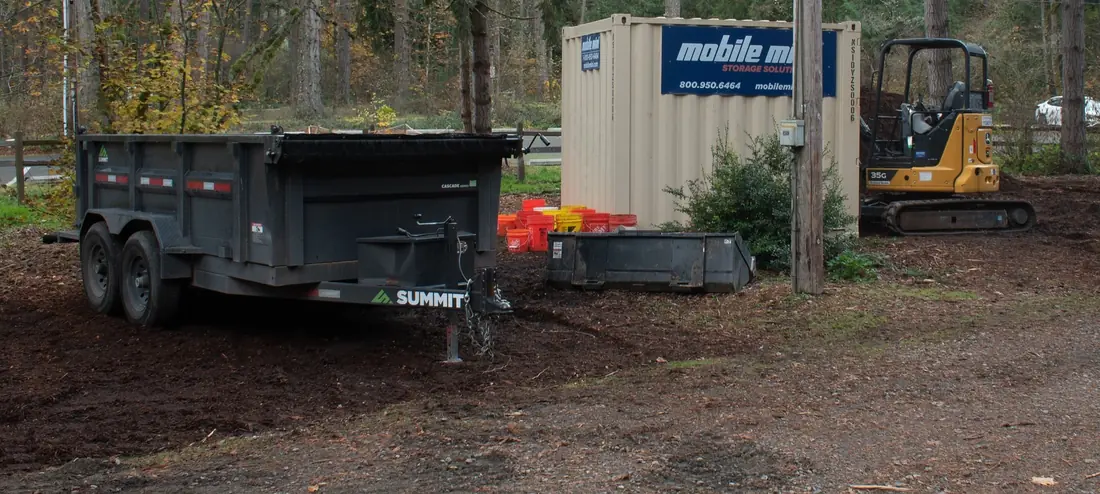

Many manufacturers lower the deck further with drop-spindle axles or torsion axles. Examples from current spec sheets:
- Big Tex 14LP: 83 inches wide in 12, 14, and 16 ft lengths, 14,000 lb GVWR. Big Tex says optional drop axles bring the deck to about 24 inches.
- PJ DL (14K Low-Profile Dump PRO): 83 inches wide in 12 to 16 ft lengths, 15,400 lb GVWR.
- PJ DE (HD Low-Pro Dump): 82.5 inches by 16 ft, 21,000 lb GVWR, with torsion axles that PJ notes help lower the deck.
"Low-profile" on a dump trailer is not a single number. It generally means the deck is under about 30 inches. Measure the one you are looking at.
What is a deckover dump trailer?
On a deckover dump trailer, the box sits on top of the main frame, above the tires. Because the box no longer has to fit between the wheels, it can be the full 96 inches wide. Most deckover dumps use low fold-down sides so you can load from the side.
Examples from current spec sheets:
- PJ D8 (96-inch Deckover Dump): 96 inches wide, 14 and 16 ft lengths, 15,400 lb GVWR, 19-inch fold-down steel sides.
- Diamond C DOD: 96 inches wide, 14 to 16 ft, 15,500 to 23,000 lb GVWR, 22-inch fold-down sides, telescopic hoist. Also offered as a gooseneck (DOD-GN).
- Load Trail DZ and GZ: 96 inches wide, 14,000 to 21,000 lb GVWR, 18-inch fold-down sides standard with 24, 36, or 48-inch options on the GZ, built on a 10-inch I-beam frame.
Dealer listings put deck heights on deckover dumps around 32 to 34 inches, and 36 inches or more on some models. Check the specific trailer.
Low-profile vs. deckover at a glance
| Factor | Low-profile | Deckover |
|---|---|---|
| Box position | Between the wheels | Above the wheels |
| Typical inside width | About 83 in | About 96 in |
| Typical deck height | 24–30 in | 32–36 in |
| Sides | Fixed, usually 18–48 in | Fold-down, often 18–24 in |
| Loading | Rear ramps, hand, machine | Rear, side, forklift |
| Center of gravity | Lower | Higher |
| Ramp angle | Gentler | Steeper or longer ramps |
| Dump point | Lower, spreads more | Higher, piles more |
Width: 83 inches vs. 96 inches
The 13 extra inches are the main reason to buy a deckover.
- Pallets. A standard 48 x 40 inch pallet fits two-wide on its 40-inch side in either trailer, but 83 inches leaves only 3 inches to spare. A 96-inch deck leaves room to place pallets with a forklift without scraping the sides.
- Wide materials. Sheet goods, timbers, and bundles close to 8 ft long can be laid crosswise on a 96-inch deck (with the sides folded down if needed). They will not lie flat crosswise in an 83-inch box.
- Equipment. Most compact equipment fits in 83 inches, but always compare your machine's width over the tires or tracks to the inside width of the box, not the overall trailer width.
If your loads are loose material shoveled, bucketed, or dumped in, width rarely matters. An 83-inch box holds plenty of dirt.
Deck height, ramps, and loading
A lower deck makes almost every kind of loading easier.
- By hand. Throwing debris or brush over a lower side wall is less work, and a wheelbarrow ramp is shorter.
- With equipment. Ramps are shorter or gentler, which matters for low-clearance machines.
- With a skid steer bucket. Either works, though a deckover's higher sides (if raised) need more lift height.
Here is what deck height does to ramp angle with common 6.5 ft (78-inch) slide-in ramps:
| Deck height | Ramp length | Ramp angle |
|---|---|---|
| 24 in | 6.5 ft | 17.9° |
| 28 in | 6.5 ft | 21.0° |
| 34 in | 6.5 ft | 25.8° |
| 34 in | 8 ft | 20.7° |
A 34-inch deckover needs 8 ft ramps to get close to the angle a 28-inch low-profile gets with 6.5 ft ramps. Longer ramps are heavier to handle and need somewhere to store them. For loading a mower, compact tractor, or skid steer, the low-profile is the easier trailer.
The deckover's answer is the fold-down side. With the sides down, a forklift can set pallets, bundles, or materials from either side without anyone climbing into the box. For supply yards and contractors who pick up palletized material, that alone can justify the design.
Center of gravity, towing, and dumping
A higher deck means a higher center of gravity. On the road, a deckover sits taller and catches more wind. When dumping, the difference matters more.
When you raise a dump box, the load's center of gravity climbs and moves rearward. On a deckover, it starts higher. On a side slope, on soft ground, or with material that hangs up in the front of the box (wet clay, frozen dirt, sticky mulch), a higher starting point means less margin before the trailer leans over. Low-profile trailers are more forgiving here.
The flip side is the dump point. A deckover dumps from higher, so material falls farther and piles more. A low-profile tends to spread material out, which is useful for driveways and base but less so if you want a tight pile.
Frame strength and build differences
Because a deckover's box has to bridge the full width above the wheels, many manufacturers build deckovers on taller frames. Load Trail, for example, uses a 10-inch I-beam on its DZ and GZ deckover dumps and an 8-inch I-beam on its DL low-profile dumps, per its published lineup. That is not a universal rule, but it reflects how much the bed has to carry.
Fold-down sides are the other big build difference. A fixed low-profile side wall is welded to the floor and stiffens the box. A fold-down side is a hinged panel held by latches, and it adds parts that wear: hinges, pins, and latches that take a beating every time material pushes on them.
Which design fits your work?
Choose a low-profile dump trailer if:
- You haul dirt, gravel, mulch, debris, or other loose material.
- You load by hand or with ramps and equipment.
- You want the lowest center of gravity and the most forgiving dumping behavior.
- You want the widest selection of sizes, side heights, and builders.
Choose a deckover dump trailer if:
- You regularly haul pallets, bundles, or wide materials.
- You load from the side with a forklift.
- You need the full 96-inch width for equipment or long items carried sideways.
- You want a higher dump point for piling material.
A lot of buyers looking at deckovers are really looking for a trailer that can do two jobs: dump and flatbed. That is a reasonable goal, and a deckover dump with fold-down sides does it better than a low-profile. If you mostly haul loose material, though, the low-profile is the better dump trailer.
For the next decisions, see What Size Dump Trailer Do I Need? and Gooseneck vs. Bumper Pull Dump Trailers. Both designs are offered with either hitch.
The bottom line
Low-profile dump trailers are the default for good reason: lower deck, easier loading, gentler ramps, and a lower center of gravity when dumping. Deckovers solve a specific problem, width and side loading, and they do it well. Decide by the shape of what you haul, then judge the trailer by its frame, floor, hinges, and hoist.
Frequently asked questions
What is the difference between a low-profile and a deckover dump trailer?
A low-profile dump trailer has its box between the wheels, which keeps the deck low (roughly 24 to 30 inches) but limits inside width to about 83 inches. A deckover puts the box above the wheels, so it can be a full 96 inches wide, but the deck sits higher, usually around 32 to 36 inches.
Is a deckover dump trailer worth it?
It is worth it if you regularly haul pallets, wide materials, or equipment that does not fit in 83 inches, or if you load from the side with a forklift. For most dirt, gravel, mulch, and debris work, a low-profile trailer does the same job with a lower center of gravity and easier loading.
Are deckover dump trailers more likely to tip?
A deckover's higher deck raises the center of gravity, especially with the box raised, so it is less forgiving on side slopes and soft ground. Any dump trailer can tip if material hangs up in the box or the ground is uneven, so dump on firm, level ground regardless of design.
How wide is a low-profile dump trailer?
Most 7 ft low-profile dump trailers measure about 82 to 83 inches inside the box. The overall trailer, including fenders, stays within the 102-inch federal width limit.
Share this guide
Link to this guide
Writing about dump trailers? You're welcome to quote this guide and link to it. Copy whichever format you need.
- URL
- https://stranktrailers.com/guides/low-profile-vs-deckover-dump-trailer
- HTML link
- <a href="https://stranktrailers.com/guides/low-profile-vs-deckover-dump-trailer">Low-Profile vs. Deckover Dump Trailers</a> (Strank Trailers)
- Citation
- Strank Trailers. "Low-Profile vs. Deckover Dump Trailers." stranktrailers.com, October 28, 2026. https://stranktrailers.com/guides/low-profile-vs-deckover-dump-trailer
Keep reading
Ownership · 11 min read
Dump Trailer Safety: Dumping, Tipping, and Power Lines
Dump trailer safety: avoiding tip-overs when dumping, OSHA power line clearances, using the bed safety prop, sticky and frozen loads, chocks, and unhitching.
Specs · 10 min read
Dump Trailer Steel Gauge Explained
Dump trailer steel gauge explained: 14, 12, 10, and 7 gauge in inches and pounds, what builders use for floors and sides, and why floor gauge matters most.
Buying · 10 min read
What Size Dump Trailer Do I Need?
Dump trailer sizes from 5x8 to 8x20, with cubic-yard capacity at 2, 3 and 4 ft sides, typical GVWR, and why weight, not volume, decides what size you need.