
How Long Do Dump Trailers Last?
How long do dump trailers last? Lifespan by component, what wears out first, what separates a 5-year trailer from a 20-year one, and what holds resale value.
By Strank Trailers8 min read
The short version
- There's no reliable industry-wide lifespan figure. A dump trailer's life depends on its frame, floor, coating, and hydraulics, and on how hard it's worked and maintained.
- Tires, bearings, brakes, batteries, and hydraulic seals are wear items with known service intervals. The frame and bed are what decide whether the trailer is worth repairing.
- Frame cracks, a rusted-through or badly dented floor, and worn hinge mounts usually end a trailer's life. The pump, cylinder, and axles can be replaced.
- Resale value follows condition, component brands, maintenance records, rust, and floor condition more than age alone.
- The IRS depreciates trailers over 5 years for tax purposes, but that is an accounting schedule, not a measure of how long a trailer lasts.
On this page
There's no single honest answer to how long a dump trailer lasts, because two trailers sold for the same use can have very different lives. A heavy-built, well-maintained dump trailer can keep working for decades. A light-built one that's overloaded and left wet can be worn out in a few years. What decides it is the steel in the frame and floor, the coating, the hydraulics, and how the trailer is loaded and cared for.
We haven't found a credible published statistic for average dump trailer lifespan, so we won't make one up. What we can do is break the trailer down by component, explain what wears out and why, and show what separates a trailer that's done in five years from one that's still working at twenty.
Dump trailer lifespan by component
Think of a dump trailer as two groups of parts. Wear items get replaced on a schedule. The structure is what you're really buying.
| Component | Type | What limits its life | Guidance |
|---|---|---|---|
| Tires | Wear item | Age, heat, overloading, underinflation | Carlisle: average 3–5 years regardless of mileage; replace by 5 |
| Wheel bearings and seals | Wear item | Lack of grease, water intrusion | Dexter: clean and repack every 12 months / 12,000 miles |
| Brake shoes and magnets | Wear item | Lining wear, magnet wear | Dexter: replace linings at 1/16"; replace magnets in pairs |
| Battery | Wear item | Deep discharges, sitting discharged, freezing | Keep charged; life depends heavily on charging habits |
| Hydraulic seals and hoses | Wear item | Contamination, heat, chafing, overpressure | Replace hoses at first sign of cracking or chafe |
| Pump and motor | Replaceable | Low voltage, moisture, contamination | Replaceable as a bolt-on unit on most trailers |
| Hinge pins and bushings | Wear item | Lack of grease, overloading | Grease monthly; replace when play develops |
| Floor | Structure | Abrasion, bucket impact, rust from wet loads | Thicker steel and closer crossmembers last longer |
| Frame and crossmembers | Structure | Fatigue cracking, overloading, rust inside tubes | Usually decides whether the trailer is worth fixing |
| Coating | Protects structure | Chips, poor surface prep, salt | Touch-up keeps rust from reaching the structure |
Tire guidance in particular varies by manufacturer, so follow the maker of the tires on your trailer.
What wears out first
Tires: age matters more than tread
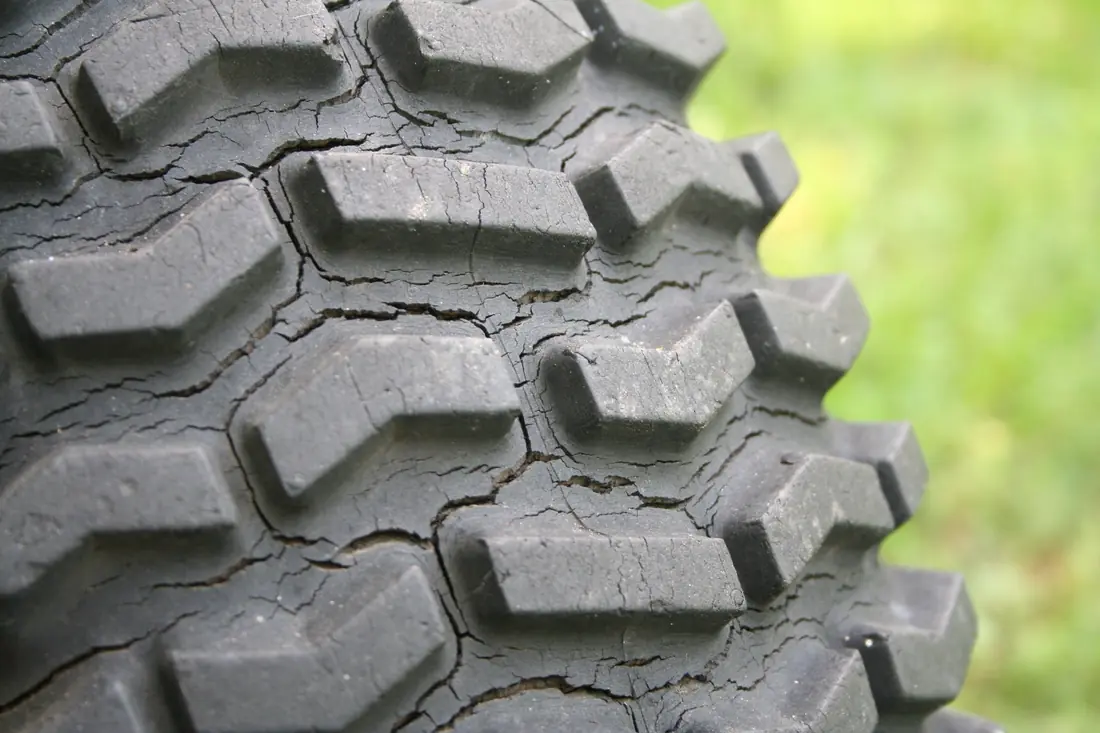
Trailer tires often age out before they wear out, especially on trailers that sit between jobs. Carlisle's trailer tire guidance puts the average life of a trailer tire at 3–5 years regardless of mileage, and says to replace after five years in all cases. Carlisle also estimates that roughly one-third of a trailer tire's strength is gone after about three years. Other tire makers publish their own age guidance, so check the maker of your tires. Read the four-digit DOT date code on the sidewall (week and year).

Running gear: bearings, brakes, and suspension
Bearings and brakes last as long as you maintain them. Dexter's schedule calls for repacking bearings every 12 months or 12,000 miles, adjusting brakes every 3,000 miles, and inspecting the springs, hangers, and suspension parts on a regular cycle. Skip the grease and a bearing can fail in a season. Keep up with it and the axle can outlast several sets of tires. The maintenance checklist lists every interval.
Battery and hydraulics
Batteries fail early when they sit discharged. The industry-standard owner's manual warns that a discharged battery can freeze and crack in storage. Pumps fail early from low voltage and water. KTI Hydraulics notes that low voltage makes the motor draw more current, and DLH Fluid Power says its DC motors aren't sealed against washing. Cylinders fail early from contaminated fluid, and from overloading that pushes the system against the relief valve again and again.
All of these are replaceable. A trailer with a dead pump isn't a dead trailer.
What actually ends a dump trailer's life
The trailer is done when the structure is no longer worth fixing. In practice, these are the failures that retire dump trailers:
- Frame cracks. These start at crossmember joints, at the hinge mounts, around spring hangers, and where the tongue meets the main rails. Cracks come from metal fatigue: repeated loading, overloading, rough roads. A crack that's welded over without addressing the cause usually comes back.
- A worn-out floor. Abrasive loads wear the floor thinner. Repeated bucket drops dent it between crossmembers. Wet material rusts it from the top. Eventually it needs replacing, and replacing a dump bed floor is a big fabrication job.
- Hinge and pivot wear. The rear hinge carries most of the load when the bed is raised. If the pins run dry, the holes wear oval and the hinge ears crack. This is fixable but labor-intensive.
- Structural rust. Rust inside tube frames and on crossmember tops can thin the steel before you see it from outside. Once rust reaches structural welds and mounts, the repair can cost more than the trailer is worth.
- Bent or twisted frame. This happens when a trailer tips while dumping, or is dumped on uneven ground, which twists the frame with the bed raised.
What separates a 5-year trailer from a 20-year trailer
Take two dump trailers with the same footprint and the same GVWR sticker. Whether each one lasts five years or twenty comes down to a few factors.
1. How much steel is in the frame and floor
Main rail size and wall thickness, how far apart the crossmembers are, and the floor gauge all determine how much stress each piece carries. A lightly built frame running near its limit on every load accumulates fatigue damage much faster than a heavier frame doing the same work. A thicker floor takes more abrasion and impact before it needs replacing. See dump trailer steel gauge explained.
2. Weld quality
Fatigue cracks usually start at welds: poor fusion, undercut, porosity, or abrupt joints that concentrate stress. Consistent, fully fused welds at the critical joints (hinge, crossmembers, tongue, hangers) are a big part of a long life. Here's how to judge weld quality.
3. Surface prep and coating
The same paint over blasted steel and over mill scale gives very different results. When rust gets under the coating, it attacks the structure. Galvanizing, or a well-applied powder coat over properly prepared steel, buys years. Drain holes and sealed seams keep water from collecting where you can't see it.
4. Hydraulics sized for the job
A hoist and pump sized with margin for the trailer's rated load work at lower pressure, run cooler, and last longer than a system that runs at its relief setting on every dump.
5. Axles, brakes, and tires rated with margin
Running gear rated right at the trailer's GVWR runs at its limit every time the trailer is full. Margin in the axle, tire load range, and brake capacity reduces heat and wear.
6. How it's used
Even the best trailer wears out fast when it's routinely overloaded, loaded from height with rock, dumped on side slopes, left full of wet material, and never greased. A modest trailer that's loaded within its rating, greased monthly, washed after winter, and stored dry can surprise you.
What determines dump trailer resale value
Used dump trailers tend to sell well when they're in good shape, partly because buyers know what new trailers cost. We won't put percentages on it, because values vary too much by region, size, brand, and market. These are the factors that move the price:
| Factor | Raises value | Lowers value |
|---|---|---|
| Frame and welds | Straight, no cracks or repairs | Cracks, visible weld repairs, twist |
| Floor | Flat, solid, original thickness | Dents between crossmembers, thin spots, rust-through |
| Rust | Surface only, well kept | Scaling, rust inside tubes, rust at hinge or crossmembers |
| Hydraulics | Lifts smoothly, no leaks, known-brand pump | Slow lift, leaks, drift, unknown pump |
| Running gear | Name-brand axles, recent bearings and brakes, newer tires | Unknown axles, old tires, no service history |
| Paperwork | Clean title, readable VIN plate, maintenance log | Missing title or VIN plate, no records |
| Configuration | Popular sizes, useful gates, tarp, ramps | Odd sizes or features few buyers want |
A maintenance log is the cheapest value boost you can give a trailer. A buyer who sees dated entries for bearing repacks, brake adjustments, and fluid changes is more confident, and more likely to pay your asking price. For the buyer's side of this, see our used dump trailer inspection checklist.
How to make your dump trailer last longer
- Stay within the GVWR every load. Weigh when unsure.
- Have buckets set down gently, and lay fines down first under rock.
- Dump only on firm, level ground, so the raised bed never twists the frame.
- Grease the hinge, cylinder pivots, and gate hinges monthly.
- Follow the axle maker's bearing, brake, and lug nut schedule.
- Keep the battery charged and keep water off the pump motor.
- Don't leave wet loads in the bed. Wash off salt and corrosive cargo.
- Touch up chips promptly and store the trailer dry. See rust prevention and storage.
The bottom line
A dump trailer lasts as long as its frame, floor, and hinge stay sound. Everything else is a wear item with a known service interval. Build quality sets how long a trailer can last, and loading and maintenance decide how close you get to it. When you buy, pay closest attention to the parts you can't easily replace.
Frequently asked questions
How many years does a dump trailer last?
It varies too much for one number. A heavily built, well-maintained trailer used for moderate loads can work for decades. A light-duty trailer that's routinely overloaded and left wet can be worn out in a few seasons. The frame, floor, and coating set the ceiling, and maintenance decides how close you get to it.
What wears out first on a dump trailer?
Tires and batteries usually go first, followed by brake parts, bearings, and hydraulic seals. These are normal wear items. Floors, hinge pins, and coatings wear more slowly, and how fast depends on what you haul and how it's loaded.
Do dump trailers hold their value?
Well-built dump trailers in good condition tend to resell well because buyers know what a new one costs. Rust, floor damage, frame repairs, and missing maintenance records cut value the most.
Is it worth buying a used dump trailer?
It can be, if the frame, floor, and hinge area are sound. The pump, battery, tires, and bearings are all replaceable and should be priced into your offer. Use a checklist and inspect it with the bed raised on its prop.
Share this guide
Link to this guide
Writing about dump trailers? You're welcome to quote this guide and link to it. Copy whichever format you need.
- URL
- https://stranktrailers.com/guides/how-long-do-dump-trailers-last
- HTML link
- <a href="https://stranktrailers.com/guides/how-long-do-dump-trailers-last">How Long Do Dump Trailers Last?</a> (Strank Trailers)
- Citation
- Strank Trailers. "How Long Do Dump Trailers Last?." stranktrailers.com, October 28, 2026. https://stranktrailers.com/guides/how-long-do-dump-trailers-last
Keep reading
Ownership · 9 min read
Dump Trailer Maintenance Checklist
A dump trailer maintenance checklist with pre-trip, weekly, monthly, and annual tasks: lug nut torque, bearings, brakes, hydraulic fluid, grease points, rust.
Specs · 10 min read
Dump Trailer Steel Gauge Explained
Dump trailer steel gauge explained: 14, 12, 10, and 7 gauge in inches and pounds, what builders use for floors and sides, and why floor gauge matters most.
Specs · 15 min read
How to Judge Weld Quality on a Trailer
How to judge weld quality on a trailer: spot undercut, porosity, cold lap, and cracks, find the welds that matter most, and know what to ask the builder.